close
Choose Your Site
Global
Social Media

Views: 0 Author: Site Editor Publish Time: 2026-10-23 Origin: Site
Picture yourself bracing a tent against gale-force winds in the dead of night. Standard hollow tent poles frequently fail during these critical moments. They easily snap under unpredictable high wind loads. They often crush under heavy snow accumulations, completely compromising your shelter. Upgrading your gear introduces a significant leap in overall durability. However, this shift also introduces new variables regarding weight and flexibility.
You must understand these structural differences before modifying your setup. Choosing the wrong diameter can ruin your shelter fabric. Selecting the wrong material can leave you stranded. This guide provides a realistic, evidence-based framework for evaluating shelter materials. We will help you determine if heavier materials suit your specific environment. You will learn exactly how to select the correct specifications. We ensure you build a resilient structure without over-engineering your tent or wasting your budget.
Use Case Suitability: Solid fiberglass rods are ideal for car camping, glamping, and semi-permanent shelters where durability outweighs weight penalties; they are entirely unsuited for ultralight backpacking.
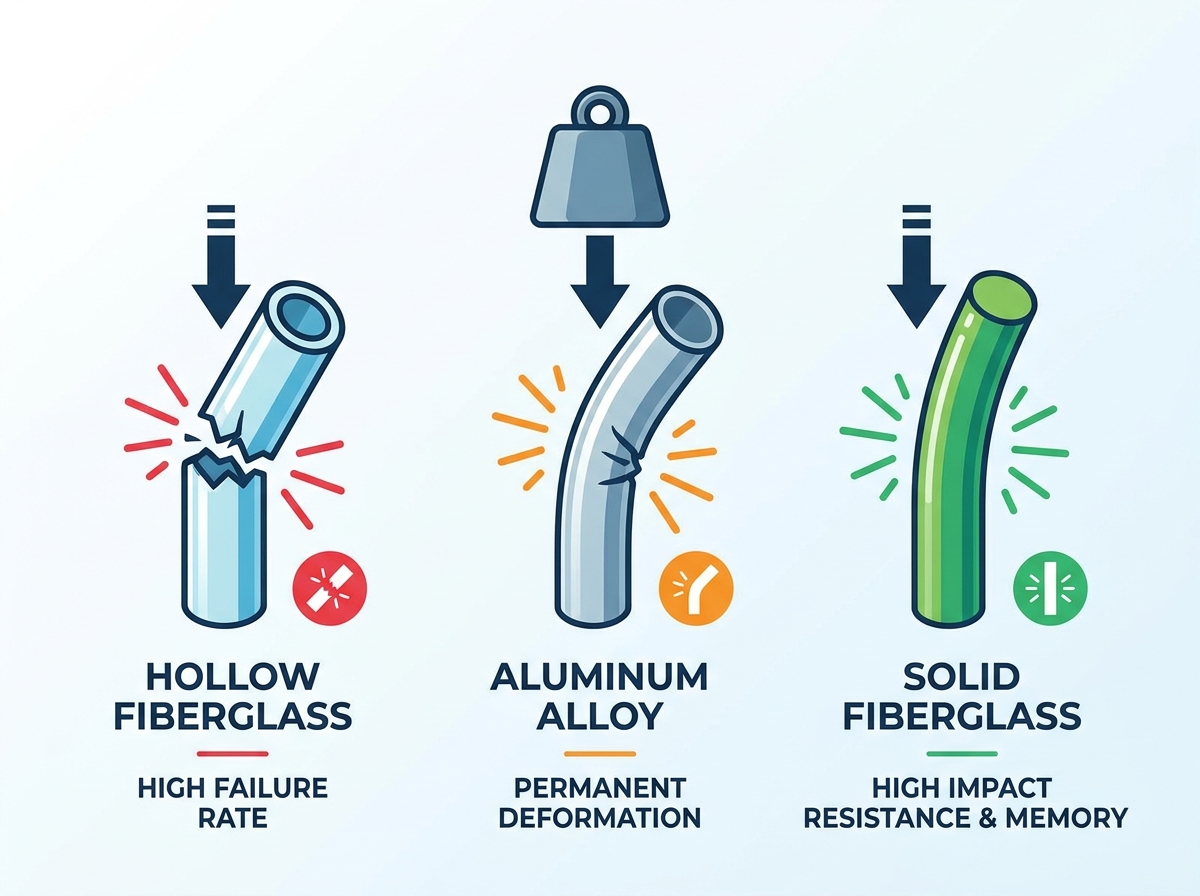
Structural Advantage: Unlike hollow poles that crush or aluminum that bends permanently, a solid fiberglass rod flexes under pressure and returns to its original shape.
Critical Specs: Sizing must account for strict bend-radius limits, UV-resistant coatings, and high-quality pultrusion processes to prevent long-term splintering.
Moving away from standard hollow fiberglass poles usually happens out of necessity. Repeated structural failures in high-stress outdoor environments drive campers to seek stronger alternatives. Standard hollow tubes simply cannot handle extreme tension. If you camp in harsh weather, you need gear capable of surviving unpredictable forces.
You must assess the specific load-bearing and flexibility requirements of your shelter. Dome tents require high flexibility to create their iconic arch. Conversely, large cabin tents demand rigid vertical support to hold up heavy canvas. Standard poles struggle to meet both demands efficiently. Rigid materials excel in static, vertical applications. They resist buckling under heavy top-loads.
Consider your long-term lifespan expectations. Replacing cheaper poles constantly drains your energy and your wallet. A one-time investment in stronger materials stops this frustrating cycle. You build it once, and it lasts for years. Identifying your target environment helps clarify this decision. Optimal scenarios include high-wind coastal camping, semi-permanent hunting shelters, and thick canvas structures. We strongly recommend using solid fiberglass rods for these demanding situations. They provide the necessary backbone to keep your shelter standing when conditions turn severe.
Choosing the right core material dictates how your shelter handles stress. Every option presents unique advantages and distinct compromises. Understanding how they behave under physical strain prevents catastrophic field failures.
Solid fiberglass offers the highest impact resistance among common options. It possesses excellent structural memory. When wind pushes your tent flat, a solid rod flexes and returns completely to its straight original shape. The major trade-off is the significant weight. It ranks as the heaviest option, but it remains moderately priced. This makes it perfect for static, high-load shelters.
Hollow fiberglass remains incredibly cheap and lightweight. However, it is highly susceptible to longitudinal splitting. Ferrule-point crushing happens frequently when you over-tighten guy-lines. Aluminum alloys, specifically 7000-series, deliver a superior strength-to-weight ratio. They are much lighter than solid options. The problem arises when aluminum bends beyond its yield point. It suffers permanent deformation. Once an aluminum pole bends, it stays bent. Aluminum also ranks as the most expensive choice.
Table: Shelter Material Characteristics Comparison
Material Type | Impact Resistance | Shape Memory | Weight Penalty | Ideal Use Case |
|---|---|---|---|---|
Solid Fiberglass | Exceptional | High (Returns to straight) | Heavy | Semi-permanent shelters, high wind |
Hollow Fiberglass | Low | Moderate | Light | Casual fair-weather camping |
7000-Series Aluminum | Moderate | Low (Prone to permanent bending) | Very Light | Backpacking, alpine expeditions |
The skeptic’s bottom line remains simple. Do not choose solid materials if transportability is your primary success criterion. If you hike ten miles into the backcountry, the weight will exhaust you. Choose solid options strictly when structural failure is not an option.
You cannot simply buy any generic rod and expect superior performance. Sourcing reliable fiberglass tent frame rods requires strict attention to manufacturing details. Precision dictates success in the field.
Diameter and tolerances matter immensely. A deviation of even 0.5mm creates massive assembly problems. If the pole is slightly too thick, it prevents the unit from fitting standard ferrules. If it is slightly too thin, it wobbles loosely inside corner hubs. Pultrusion quality serves as another critical metric. You must look for continuous strand pultrusion. Poorly manufactured items show surface inconsistencies immediately. They often harbor internal air bubbles. These defects make them prone to premature micro-fracturing under stress.
UV resistance dictates longevity. Bare fibers degrade incredibly fast in direct sunlight. The sun aggressively breaks down standard epoxy resins. You must assess whether the manufacturer includes a UV-inhibiting resin compound. A protective surface veil also extends the functional life of the equipment. Furthermore, evaluate temperature ratings closely. Sub-zero temperatures change material chemistry. Standard resins become dangerously brittle in freezing conditions. If you camp in the winter, verify cold-weather performance claims before purchasing.
Working with solid structural materials demands proper planning and specific tools. Calculating the minimum bend radius prevents disastrous setup errors. Solid profiles feature a much stiffer bend radius than hollow tubes. You cannot force them into tight arches. Over-flexing causes catastrophic failure. You must match the pole diameter to your specific shelter arch curves. Thicker diameters belong in straight, vertical applications. Thinner diameters handle gentle dome curves.
Resizing pieces at home introduces physical risks. You cannot snap them over your knee. Cutting requires fine-tooth hacksaws or high-speed Dremel tools. You must wrap the cutting zone tightly in heavy-duty tape. This simple step prevents the edges from splintering. Always wear proper Personal Protective Equipment (PPE). Respirators and heavy gloves are mandatory. You must avoid inhaling microscopic glass dust during the modification process.
Hardware integration presents a unique engineering challenge. You must source the correct external ferrules. A solid core means you cannot run elastic shock cord internally. This changes how you assemble the frame. Sections must connect securely using tight-fitting external metal sleeves. Some users develop custom external tethering systems to keep pieces organized. Every single fiberglass rod requires end-caps. Uncapped ends will quickly abrade and puncture your expensive tent fabric.
Honest evaluation means acknowledging material limitations. The splinter hazard remains the primary user complaint. When these sturdy poles eventually fail or wear down, they shed. Microscopic, painful glass splinters embed themselves into your skin. Handling older, weathered poles without gloves invites discomfort. You must visually inspect your frame before every camping trip.
The weight penalty requires a transparent assessment. Solid poles add significant pounds to your overall gear load out. If you transport your gear in a truck, this matters very little. If you manually carry your gear across a campsite, you will feel every extra ounce. You must balance the need for invincibility against your physical carrying capacity.
Vibration and wind rattle also behave differently. Solid poles transfer kinetic energy aggressively. Unlike flexible aluminum, a stiff frame absorbs wind gusts forcefully. This transfers aggressive shaking directly down into the ground stakes. You must adjust your shelter’s guy-line setup. Upgrading to heavy-duty, energy-absorbing guy-lines prevents stakes from pulling out during violent storms.
Finding the right supplier determines the ultimate quality of your upgrade. Deciding where to buy dictates your customization options. You can buy pre-cut replacement kits from standard outdoor retailers. These offer convenience but limit your diameter choices. Alternatively, you can order raw pultruded stock from industrial B2B manufacturers. Industrial suppliers offer precise dimensions and bulk pricing.
You must ask suppliers specific technical questions. Do not accept generic marketing answers. Ask them direct engineering questions to gauge their reliability.
“What is the glass-to-resin ratio?” A higher glass content creates higher overall strength but yields lower flexibility. Knowing this ratio helps you match the pole to your tent design.
“Are these poles coated for UV exposure?” Ensure they explicitly confirm the presence of UV-inhibiting layers.
“What is the stated minimum bend radius for this specific diameter?” Force them to provide exact curvature limits to avoid snapping poles during setup.
Your next steps require precise action. Measure your existing shelter hubs using digital calipers. Estimate the total linear footage needed for your entire frame. Finally, order a single test rod before committing to a massive bulk structural replacement. Testing one piece guarantees compatibility.
Solid materials offer the ultimate solution for stationary, weather-battered camping shelters. They provide unmatched resilience against heavy winds and snow.
You must account for strict bend-radius limits. Over-flexing guarantees failure.
The increased weight limits your mobility. Reserve this upgrade for vehicle-supported camping trips.
Prioritize accurate diameter measurements over finding the absolute lowest price. A cheap pole guarantees frustration if it refuses to fit your corner hubs.
Always verify UV-resistant coatings. Sun damage ruins unprotected resins quickly, leading to dangerous splintering.
A: Yes, but the diameter must be thin enough to accommodate the curve without exceeding its structural bend radius. Solid rods are significantly stiffer than hollow ones of the same diameter. You must carefully calculate the required arch before attempting to bend them.
A: Minor splintering can be mitigated with fine-grit sandpaper and a coating of exterior-grade epoxy or heavy-duty shrink tubing. You must seal the fibers completely. However, compromised structural integrity usually necessitates full replacement to maintain safety.
A: Because they lack a hollow core, you cannot run elastic cord through the center. Solid sections must be connected via tight-fitting external ferrules. You can also build custom external tethering systems to keep the pole segments organized during transport.