Jiangxi Dekai New Materials Co., Ltd
Fiberglass rod/Tube/Flat bar/Driveway marker

Views: 0 Author: Site Editor Publish Time: 2026-10-27 Origin: Site
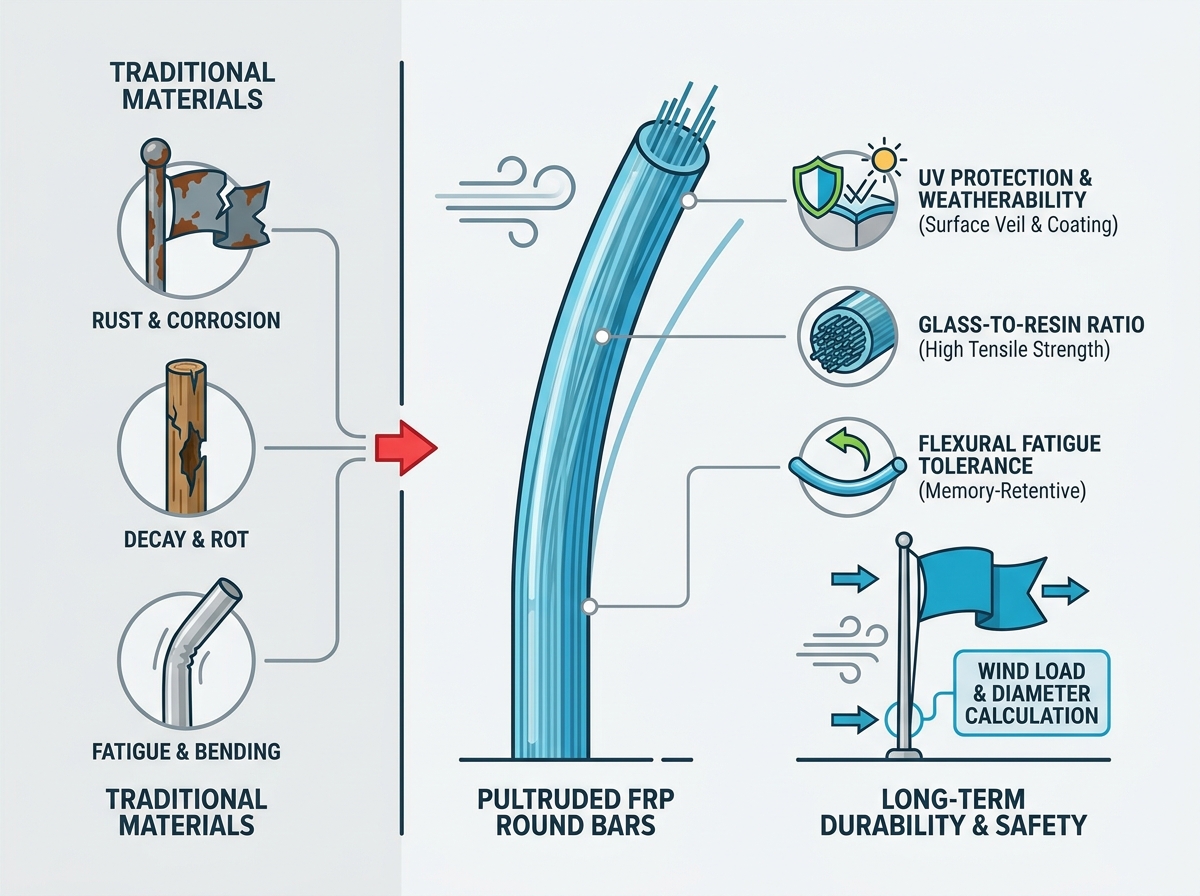
Outdoor signage heavily relies on durable materials. For decades, manufacturers used traditional metals and wood. Today, this is rapidly changing. Wood rots quickly. Steel rusts. Aluminum bends under severe stress. Because of these constant failures, composite materials now dominate modern structural designs.
Fiber Reinforced Polymer (FRP) provides exceptional strength. It remains incredibly lightweight. However, you must choose these products carefully. Manufacturers do not engineer all composites equally. Extreme wind cycling and intense UV exposure quickly destroy poorly made rods. Surface degradation often leads to structural failure. We created this guide to solve this exact problem.
You will learn how to evaluate material specifications accurately. We provide a transparent, technical framework to size and source these components correctly. This ensures your installations remain safe, long-lasting, and highly efficient. By understanding these engineering principles, you can confidently select the right materials for any outdoor environment.
Choosing the correct resin system and UV protection strategy is critical to preventing "fiber blooming" and material degradation.
Selecting the right diameter depends on a careful calculation of wind loads, pole height, and required flexibility.
While primarily used for flagpoles, specific FRP specifications translate directly to high-strain horizontal applications like banner support poles.
Evaluating a supplier requires looking beyond unit cost to consider batch consistency, custom pigmentation capabilities, and logistical support for long-freight shipping.
Traditional materials constantly fight a losing battle against nature. Steel oxidizes rapidly. Wood absorbs moisture and rots over time. High humidity accelerates these natural decay processes. Coastal environments are particularly brutal. Salt spray eats through metal protective coatings in months.
FRP stands entirely immune to rust and rot. The polymer matrix seals the structural glass fibers away from moisture. It does not react to airborne salts or industrial chemicals. You can install an FRP pole on a beachfront property today. Decades later, it will still retain its structural integrity. This absolute corrosion resistance makes composites superior for challenging climates.
Installing tall vertical structures always carries electrical risks. Metal flagpoles conduct electricity highly efficiently. If lightning strikes a steel or aluminum pole, the current travels directly into the ground. It can easily damage nearby structures. It also poses a massive fatal risk to bystanders.
Fiberglass provides incredible insulating properties. It is non-conductive. This completely eliminates electrical transmission hazards. Installing these poles near overhead power lines becomes significantly safer. Many utility companies mandate fiberglass for this exact safety reason. It protects installation crews and the general public equally.
Wind never applies a steady, perfectly even force. It gusts, drops, and changes direction constantly. This creates dynamic cycling loads. Aluminum yields under repetitive bending. It eventually suffers permanent deformation. Once metal bends past its yield point, it stays bent.
The pultrusion process solves this issue through continuous reinforcement. It aligns long glass fibers uniformly through the matrix. This alignment creates a memory-retentive material. It flexes dramatically under high wind loads. When the wind stops, the pole snaps back to perfectly straight. It endures millions of bending cycles without suffering fatigue or yielding.
You must choose the correct resin formulation for your environment. Standard Isophthalic Polyester serves most general outdoor applications perfectly. It balances mechanical strength and cost-efficiency. It handles typical rain, sun, and temperature swings effortlessly.
Vinyl Ester represents a significant upgrade. It provides much higher chemical resistance. We recommend Vinyl Ester for extreme coastal installations. Industrial areas featuring high atmospheric pollutants also require this upgrade. It offers superior cross-linking density. This density prevents microscopic moisture intrusion over time.
Resin System Characteristics
Resin Type | Best Application | Environmental Resistance | Flexural Strength |
|---|---|---|---|
Standard Isophthalic Polyester | Residential flagpoles, mild climates | High | Excellent |
Vinyl Ester | Coastal areas, industrial zones | Extreme | Superior |
Ultraviolet radiation destroys unprotected plastics. Unprotected FRP suffers from a condition called "fiber blooming." The UV rays break down the surface resin layer. This deterioration eventually exposes the internal glass fibers. The pole then feels prickly to the touch. Structural integrity drops rapidly after blooming occurs.
Quality pultruded FRP round bars utilize multiple defense layers. Manufacturers add synthetic surface veils during the pultrusion process. This veil creates a resin-rich outer boundary. It pushes the glass fibers deeper into the profile. For maximum lifespan, you should also apply secondary protective coatings. A two-part polyurethane clear coat easily doubles the material lifespan under harsh sun.
Tensile strength comes entirely from the glass fibers. Longitudinal continuous roving pulls tightly through the heated die. This orientation gives the rod its incredible longitudinal strength. The resin simply acts as the glue holding these fibers in place.
You must verify the glass content percentage. A standard acceptable glass content ranges between 60% and 70%. If the ratio drops below 60%, the pole becomes overly flexible and weak. If it exceeds 70%, the pole lacks enough resin to protect the fibers. Maintaining this exact ratio guarantees optimal rigidity in flagpole applications.
You must decide between solid geometry and hollow structural shapes. Solid round bars offer massive impact resistance. They work perfectly for ATV flags, safety whips, and small residential mounts. Their solid core handles sharp, sudden shocks easily without crushing.
High-altitude commercial flagpoles demand hollow structural tubes. Hollow tubes provide a higher section modulus relative to their weight. They offer better stiffness over long vertical spans. Using a solid rod for a 30-foot commercial pole adds unnecessary weight. It also complicates shipping logistics.
Preventing excessive deflection requires strict mathematical guidelines. We call this excessive bending "whipping." A rod whipping violently damages flags and mounting hardware. You must match the base diameter directly to the unsupported height.
As a general engineering rule, increase the diameter as the unsupported height grows. Fiberglass flagpole rods usually require a tapered design for heights exceeding 20 feet. If you use a continuous diameter rod, keep the total height under 10 feet. Always refer to manufacturer deflection charts before finalizing your order.
Flags act identically to boat sails. They capture wind and translate it into sheer stress. The wind force multiplies exponentially based on the flag's surface area. A slight breeze on a massive flag generates hundreds of pounds of force.
You must calculate this sheer stress at the mounting base. Engineers measure the maximum expected wind gust in your specific geographic zone. They combine this wind speed with the square footage of your fabric. This calculation dictates the minimum required flexural strength of the pole.
Mounting hardware often destroys weak poles. U-bolts, set screws, and clamping brackets apply severe compressive forces. We call this radial pressure "hoop stress." Poorly manufactured hollow tubes easily crush or fracture under tightening pressure.
Solid rods naturally resist crushing forces. If you utilize hollow tubes, you must reinforce the mounting zone. Inserting a solid internal sleeve at the clamping point prevents hardware-induced fracturing. Always tighten brackets using calibrated torque wrenches.
Street banners experience entirely different load profiles. Vertical flagpoles bend in any direction based on wind shifts. Horizontal arms deal with permanent static gravity loads. They hold the weight of heavy vinyl banners constantly.
Dynamic loads also change. Wind hits horizontal banners broadly. This pushes the horizontal arm backward toward the mounting post. You must specify materials featuring higher stiffness metrics for horizontal usage. Bending horizontally looks visually unappealing and damages the banner fabric.
Integration dictates success. Round bars must fit securely into wall-mount brackets. They also integrate with tensioning systems and street-lamp banding. Dimensional accuracy becomes absolutely critical here. A rod slightly too large will not enter the bracket.
A rod too small rattles and eventually fractures. Quality suppliers maintain strict dimensional tolerances. They ensure your banner support poles slide seamlessly into standardized cast-aluminum brackets. Always verify tolerance specifications before placing bulk orders.
Smart engineering saves money. You do not need an infinitely rigid pole. Engineered flexibility actually protects your entire installation. We call this the "flex-to-spill" mechanism.
When sudden hurricane-force winds hit, rigid metal poles snap. Rigid brackets tear directly out of brick walls. An FRP banner arm bends backward gently. This bending action reduces the fabric's total surface area exposed to the wind. It "spills" the wind away. Once the gust passes, the arm returns to its original position safely.
Inconsistent manufacturing ruins bulk installations. Some suppliers struggle to maintain uniform resin distribution. This causes structural weak points hidden inside the rod. You will only discover these flaws when the pole snaps during a storm.
Always shortlist suppliers holding active ISO certifications. They follow strict quality control audits. They guarantee uniform resin wetting across every single batch. They also ensure exact dimensional tolerances. Consistent diameters mean your installation crews never fight to fit rods into standard hardware.
Post-production painting wastes time and money. Paint scratches easily during transport and installation. Paint also flakes off after years of sun exposure. You can avoid these headaches entirely through better manufacturing choices.
Evaluate whether a supplier offers molded-in custom pigmentation. Adding pigments directly into the liquid resin creates a permanent color. The color runs entirely through the solid profile. If the rod scratches, the color remains identical underneath. This eliminates repainting chores forever.
Shipping long materials creates massive headaches. Pultruded solid rods do not collapse. They do not fold. Shipping a 20-foot solid rod requires specialized long-freight carriers. These logistical hurdles often destroy project budgets unexpectedly.
Discuss LTL (Less Than Truckload) freight costs early. Ask about Minimum Order Quantities (MOQs). Some suppliers force you to buy thousands of feet. Find a partner who provides transparent freight estimates and flexible MOQs to match your exact project scope.
Never buy blindly based on a website photo. Engineering failures cost far more than material testing. Request detailed Material Data Sheets (MDS) from your shortlisted suppliers. These documents prove the material's structural claims.
Ask for independent deflection testing reports. Finally, order physical samples. Cut the sample open. Inspect the glass distribution visually. Clamp it into your specific mounting hardware to verify the fit. Only commit to a full production run after completing these physical verifications.
Evaluate your environment carefully to choose between standard Polyester and heavy-duty Vinyl Ester resins.
Always prioritize UV protection by ensuring synthetic veils are present in the pultrusion process.
Calculate wind loads and flag surface area before finalizing your diameter and wall thickness.
Demand precise dimensional tolerances from ISO-certified suppliers to guarantee bracket compatibility.
Request physical samples and material data sheets prior to launching mass production orders.
Deploying reliable composite structures requires careful planning. You must match specific environmental threats directly with the correct resin, glass content, and diameter. Do not chase the absolute lowest unit price. Instead, prioritize suppliers offering robust engineering support and highly transparent testing data. This strategy guarantees a safe, durable, and highly successful installation.
A: High-quality pultruded FRP round bars typically last between 15 and 25 years outdoors. This lifespan heavily depends on proper UV protection. Manufacturers must include synthetic surface veils during production. Adding a secondary two-part polyurethane clear coat easily extends this lifespan past 25 years in harsh climates.
A: Yes. However, integral resin pigmentation offers better results. Manufacturers mix color directly into the liquid resin before pultrusion. This creates permanent color throughout the entire rod. It never chips or flakes. Post-pultrusion painting works, but it requires regular maintenance and touch-ups over time.
A: Properly sized FRP flagpoles rarely snap. They feature an exceptionally high flexural threshold. They bend deeply under stress, spilling the wind naturally. As long as you calculate wind loads correctly and select the appropriate diameter, the pole will not reach its ultimate tensile failure point.
A: Standard wood blades dull quickly and splinter the fiberglass. You must use fine-tooth carbide or diamond-coated blades for clean cuts. Always wear proper Personal Protective Equipment (PPE). You must wear a respirator, safety glasses, and gloves to protect against hazardous fiberglass dust.