
close
Choose Your Site
Global
Social Media


Views: 0 Author: Site Editor Publish Time: 2026-10-12 Origin: Site


Moving heavy drapery panels places immense stress on standard operational components. You see this dynamic constantly in bustling commercial spaces, luxury hospitality venues, and high-end residential settings. Traditional plastic or hollow metal wands simply cannot handle the daily abuse they endure. They frequently bend, snap, or degrade over time, leading to severe fabric damage and sudden hardware failure. Users often grab the drapes directly when a wand breaks, pulling track glides right off the wall.
Upgrading to curtain wands manufactured with high-strength composite materials ensures long-term operational integrity. This comprehensive guide provides a transparent, criteria-driven framework for making the right structural choice. You will learn how to accurately evaluate, size, and select optimal baton systems for your heavy-duty environments. By the end, you can confidently specify robust solutions that prevent recurring maintenance headaches and protect expensive textiles.
High-strength composite rods (like pultruded fiberglass) offer superior tensile strength and flexibility compared to standard acrylic or hollow steel.
Wand length should be calculated based on standard ergonomic reach heights (typically 36 to 45 inches off the floor), not just curtain length.
Attachment points (clips vs. snap-hooks) are the most common points of failure; matching the wand hardware to your existing window treatment hardware is critical for load distribution.
UV resistance and structural fatigue rates must be evaluated for sun-facing window treatments to prevent material brittleness over time.
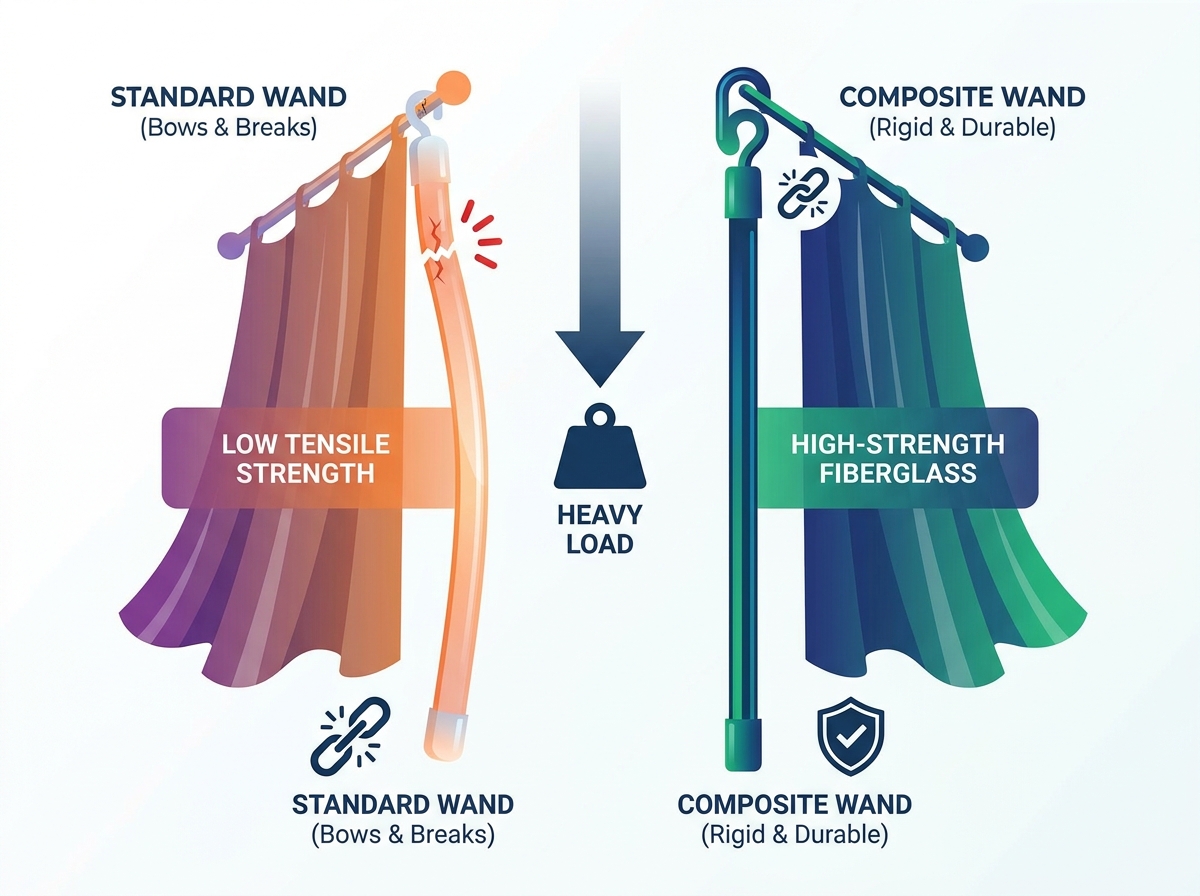
Standard acrylic or hollow metal batons often fail under intense dynamic loads. Heavy, lined, or blackout curtains create significant mechanical drag across the track. When a user pulls the baton, the material must absorb sudden kinetic energy. Most basic plastics simply cannot handle this repeated mechanical strain. They eventually snap near the top connection point, leaving sharp, dangerous edges behind.
Sunlight exposure accelerates this degradation significantly in south-facing rooms. Constant UV rays break down the complex chemical bonds inside standard plastics. The material becomes intensely brittle over a short period. A wand might feel sturdy during initial installation. Six months later, it shatters unexpectedly in a user’s hand. Hollow metal rods face entirely different environmental challenges. They resist UV damage well but suffer deeply from metal fatigue. Continual bending weakens the thin steel walls, leading to eventual collapse.
Wand failures carry a severe hidden penalty for property managers. When a baton breaks, users inevitably resort to pulling the fabric directly. Natural hand oils quickly soil the leading edges of expensive custom drapes. Aggressive tugging strains the delicate carrier track mounted above. It stretches the heavy fabric and violently rips out the stitched pleats.
A truly functional wand must meet strict, uncompromising success criteria:
Smooth Operation: It must pull extremely heavy loads without bowing excessively.
UV Resilience: It must withstand direct, daily sunlight exposure without losing structural integrity.
Load Bearing: It must effortlessly bear the curtain's aggressive drag resistance without transferring shock to the track.
Choosing the right material dictates long-term performance. The market typically offers three primary solution categories. You must understand the distinct behavior of each material under stress.
Clear acrylic or basic plastic wands dominate residential markets. They cost very little to produce. They look aesthetically discreet against light fabrics. However, they are highly prone to snapping under tension. Sunlight quickly causes them to turn an unappealing yellow hue, ruining the window's aesthetic.
Hollow metal or steel batons offer better initial rigidity. They easily match metallic room fixtures like lamps or door handles. Unfortunately, they are quite heavy. Users often swing them accidentally during operation, denting walls or scratching glass panes. The hollow core makes them highly vulnerable to permanent kinking if someone pulls them at an awkward angle.
This brings us to modern engineered alternatives. Specifying high-strength composite rods solves almost all operational issues. These blends, primarily utilizing advanced carbon or fiberglass, deliver an incredible strength-to-weight ratio. They flex gracefully under heavy pressure. Most importantly, they return to their original straight shape without permanent deformation. They also resist rust and environmental corrosion completely.
We evaluate these materials using two core metrics: deflection rates and lifecycle longevity. Deflection measures how much a rod bends under an active pulling load. Lifecycles track how many pull cycles occur before catastrophic failure. Fiberglass dominates both categories. It balances reasonable production costs, supreme durability, and excellent paintability. It has become the definitive industry standard for demanding hospitality and commercial environments.
Curtain Wand Material Performance Matrix
Material Category | Deflection Rate under Load | UV Degradation Resistance | Expected Lifecycle |
|---|---|---|---|
Standard Clear Acrylic | High (Snaps easily) | Low (Turns yellow rapidly) | Short |
Hollow Metal/Steel | Low (Prone to permanent kinks) | High | Medium |
Pultruded Fiberglass | Moderate (Flexes and recovers) | High (UV stabilized coatings) | Very Long |
Rod diameter directly impacts operational rigidity. Selecting the right thickness matters just as much as the material itself. A 3/8-inch profile works beautifully for standard hotel shears or lightweight residential panels. For ultra-heavy blackout drapes, you need substantial structural support. Upgrading to a 1/2-inch or 5/8-inch profile prevents unwanted flexing during aggressive use.
Calculating optimal length requires a highly standardized approach. We call this the "By Size" framework. Many inexperienced buyers mistakenly base wand length solely on total curtain drop. Instead, focus entirely on user ergonomics. The bottom of the wand should rest comfortably at hand level. This typically lands somewhere between 36 and 45 inches from the floor surface. You actively want to prevent users from reaching up uncomfortably or bending down awkwardly to grab the rod.
Follow these ordered steps to calculate the perfect drop dimension:
Measure the precise total distance from the top carrier track down to the floor.
Subtract 40 inches (the universally accepted average comfortable hand height).
The resulting number is your absolute ideal baton length.
High-ceiling and custom drapery scenarios present unique structural challenges. A 12-foot ceiling might require extra-long composite wands exceeding 60 inches. In these extreme cases, fiberglass curtain wands excel. They remain incredibly lightweight even at extended lengths, preventing excess strain on the master carrier.
You must constantly balance visual weight against physical weight. Thicker wands provide a much better ergonomic grip for the user. However, a bulky baton might interfere with the delicate aesthetic of sheer curtains. Choose a diameter that feels sturdy in the hand without overwhelming the visual design of the window.
A robust wand is only as reliable as its topmost connection. The baton itself rarely fails in a premium setup. Instead, the integration point gives way under stress. You must scrutinize the connection to the carrier track closely.
Different attachment styles offer varying levels of security and operational smoothness:
Swivel snaphooks: These are the gold standard for heavy drapes. They rotate freely 360 degrees. This rotation prevents destructive torque and twisting motions from transferring upward into the track system.
Steel split rings: These provide extremely high physical security. They will not pull apart under heavy loads. However, they offer a lower ease of replacement. Maintenance teams need dedicated tools to swap them out quickly.
Plastic clips: These represent the weakest possible link. We highly advise against using basic plastic clips in any heavy-duty commercial or high-end residential scenario.
Achieving perfect mechanical synergy with your existing window treatment hardware is absolutely critical. Ensure the wand's attachment mechanism fits seamlessly into existing rings, traverse glides, or grommet systems. A mismatched hook will bind. It distributes the pulling load unevenly, leading to premature track failure and friction.
Many property owners force thick steel split rings through tiny plastic carrier eyelets. The metal slowly saws through the softer plastic over time. Always verify that your chosen attachment clip matches the material density of the master carrier above.
Many interior designers raise valid concerns about the "industrial look" of composite materials. Raw fiberglass can look utilitarian. It occasionally clashes with sophisticated interior design schemes. You must evaluate the available aesthetic finishes carefully to maintain room harmony.
Modern manufacturing techniques solve this visual hurdle completely. Look for wands featuring premium baked-on finishes or powder coating. High-grade shrink wrapping also provides excellent visual appeal and a smooth texture. These advanced outer coatings will not chip or flake away over time. They withstand aggressive clashing against surrounding metallic fixtures or glass panes.
Color matching strategies require a deliberate design choice. You generally have two distinct paths. First, you can match the baton color directly to the drapery fabric. A white wand positioned against white shears blends in completely. It virtually disappears from sight, maintaining a clean visual line.
Alternatively, you can match the wand to the track and rings above. If you utilize matte black rings, a matte black baton looks highly intentional. It frames the window elegantly. Darker composites also hide finger smudges exceptionally well in high-traffic commercial spaces.
Upgrading a whole home or executing a massive commercial project requires rigorous vendor vetting. You cannot rely on generic marketing buzzwords. Implementation success depends entirely on product consistency across hundreds of units.
When evaluating a supplier, demand transparent load-bearing specifications. Do not settle for vague "heavy-duty" claims on a product sheet. Ask for actual deflection testing data. You need to know exactly how many pounds of drag the rod can handle before bending permanently.
Warranty coverage provides excellent insight into manufacturer confidence. Look for suppliers offering explicit, written guarantees. They should warranty the product against severe UV degradation, finish flaking, and mid-shaft snapping.
Custom sizing capabilities remain another major indicator of vendor quality. Off-the-shelf lengths rarely fit bespoke architectural windows perfectly. A capable supplier will cut and finish composite rods to your exact ergonomic measurements before shipping.
Take immediate action before signing a large purchase order. Request a physical sample. Put it directly in the hands of your maintenance team. Test its deflection against the absolute heaviest drape in your current project. Audit your existing attachment rings to confirm mechanical compatibility. These small verification steps prevent massive installation headaches later.
Investing in premium operational components fundamentally changes facility management and daily residential comfort. It eliminates recurring maintenance tickets for broken batons. It actively protects expensive designer fabrics from daily handling damage and unsightly hand oils. Flexible, UV-resistant composites easily outlast traditional plastics and cheap metals, ensuring long-term reliability.
A well-specified wand operates silently, pulls smoothly, and blends beautifully into the surrounding architecture. Do not treat this crucial touchpoint as an afterthought.
Measure your ideal drop height using the standard 40-inch ergonomic deduction rule.
Audit your existing master carriers to verify swivel snaphook compatibility.
Request physical samples from your shortlisted suppliers to test deflection rates under live loads.
Standardize your wand lengths across similar window heights to streamline future facility replacements.
A: Raw fiberglass edges can be abrasive, but premium wands mitigate this risk completely. High-quality composite rods feature smooth, rounded rubber or plastic end-caps. These caps act as a protective bumper. If a user accidentally swings the baton against the glass or painted drywall, the soft cap prevents any scratches or dents.
A: The baton itself can typically pull well over 50 pounds of direct drag without snapping. However, the true weight limit is usually dictated by your track system or carrier glide. The weakest link is almost always the plastic master carrier above, not the composite rod in your hand.
A: Yes. Many modern motorized tracks allow for manual overrides. You can attach a composite wand directly to the master carrier of a motorized system. This lets guests or residents open the drapes manually without stripping the delicate internal motor gears during a power outage or unprompted pull.
A: You rarely need to remove the main track. Simply reach up to the master carrier glide located at the leading edge of the fabric. Unclip the old baton from the eyelet. Slide the new swivel snaphook or split ring through the same hole. The entire process takes just seconds.
