
close
Choose Your Site
Global
Social Media


Views: 0 Author: Site Editor Publish Time: 2026-07-08 Origin: Site


When engineering lightweight, durable structures, material selection dictates your success or failure. Buyers often default to solid fiberglass profiles. They assume more mass universally equals more strength. This common assumption overlooks basic structural physics.
Solid fiberglass resists crushing incredibly well, but it adds unnecessary weight to a build. Over long horizontal spans, a heavy solid profile will sag significantly under its own weight. Understanding how a profile’s geometry affects its stiffness, flexibility, and overall mass is critical for your project. Making the wrong choice leads to premature material failure, excessive weight, or inadequate structural rigidity.
In this guide, we provide an objective, physics-backed evaluation framework. You will learn how to evaluate and choose the correct fiberglass profile. We will break down load types, weight constraints, and environmental factors so you can specify the perfect material for your specific application.
Stiffness-to-Weight: Fibreglass hollow tubes offer significantly higher rigidity and a superior stiffness-to-weight ratio compared to solid rods of the same weight.
Crush & Impact Resistance: Solid rods excel in environments requiring high crush resistance, immense flexibility, and impact tolerance.
Load Type Dictates Choice: Tubes are optimal for structural framing and low-deflection requirements; solid rods are ideal for dynamic bending and direct soil insertion.
Failure Modes Differ: Solid rods typically fail through extreme splintering after heavy over-bending, whereas hollow tubes are vulnerable to localized crushing and side-wall buckling.
In the world of composite engineering, "strength" is not a single, universal metric. You must define what specific forces your material will face. People often confuse a material's raw pulling strength with its ability to remain rigid under a load.
Tensile strength refers to a material's ability to resist being pulled apart. Fiberglass excels at this. The raw glass fibers possess immense tensile strength. However, tensile strength does not equal bending stiffness. Bending stiffness measures how well a structure resists flexing when a load presses against its side. If you need a material to stay perfectly straight under a heavy lateral load, high bending stiffness matters much more than raw tensile strength.
Geometry plays a massive role in material performance. When you bend a rod, the highest stress occurs on the extreme outer edges. The center of the rod, known as the neutral axis, experiences almost zero stress.
A hollow profile takes advantage of this physics principle. By moving the material away from the central neutral axis and concentrating it on the outer walls, you dramatically increase the moment of inertia. This geometric shift provides excellent rigidity. You gain immense stiffness without adding the proportional weight of a solid core.
While tubes win on stiffness-to-weight ratios, solid cross-sections excel in brutal, high-impact environments. A solid fiberglass profile resists severe compression, crushing, and sheer forces. Because there is no internal void, the profile cannot collapse inward. The continuous mass of glass and resin absorbs direct blunt force trauma much better than any thin-walled geometric shape.
Engineers prefer hollow profiles when weight reduction and dimensional stability are primary goals. These profiles offer distinct advantages in modern structural applications.
Maximized rigidity over long spans: The geometry inherently resists bending. This keeps long sections remarkably straight.
Drastic weight reduction: You can achieve massive weight savings. This makes them perfect for weight-critical applications like drone frames, camera rigs, and telescoping poles.
Internal cavity utility: The hollow center serves a functional purpose. You can route electrical cables through the center. You can also insert internal joining sleeves for seamless structural connections.
These advantages make fibreglass hollow tubes a top choice for modern structural framing.
Hollow profiles are not indestructible. They carry specific vulnerabilities you must account for during the design phase.
Lower hoop strength: Hoop strength refers to a tube's ability to withstand radial compression. If you clamp a tube too tightly, it will crack. If struck hard from the side, the wall can collapse.
Complex load calculations: You cannot simply guess the required dimensions. A tube requires specific wall-thickness calculations based on your expected structural loads to prevent side-wall buckling.
Due to their high stiffness and low weight, hollow tubes shine in specific use cases. You will find them in high-wind antenna masts and lightweight structural framing. They also serve as the primary structural booms for RC aircraft and provide rigid handle extensions for professional cleaning tools.
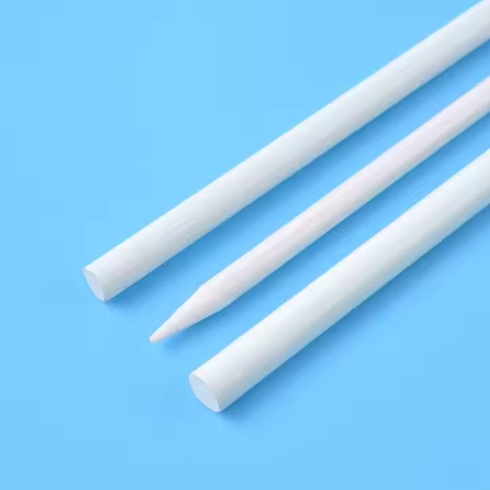
When environmental conditions become harsh and unpredictable, solid profiles step up. They trade weight efficiency for sheer, brute-force survivability.
Maximum durability: They withstand localized impact and heavy lateral strikes without structural failure.
High memory flex: A solid rod can bend significantly under heavy loads. Once the load releases, the rod returns to a dead straight position without snapping.
Impervious to side-wall crushing: You can clamp, bolt, or squeeze a solid rod tightly without worrying about crushing a hollow void.
Despite their ruggedness, solid profiles carry physical limitations.
Excessive weight: Their heavy mass makes them completely unviable for aerospace applications or lightweight structural frames.
High sag over distance: Because of their own heavy weight, solid profiles experience significant deflection over long horizontal spans. A long solid rod will bow downward naturally.
Solid profiles dominate in rugged outdoor and industrial sectors. They make perfect solid fiberglass garden stakes because they withstand repetitive hammer blows into hard soil. You also see them used as heavy-duty fishing blanks, industrial grating supports, and high-impact flexible agricultural fencing.
Choosing between these two profiles requires a strict evaluation of your project's demands. Use this detailed framework to make an objective engineering decision.
When you design a structure, weight budgets often dictate material choices. If your project spans a long distance, a solid profile will droop under its own mass. The outer fibers do all the work while the inner mass simply adds dead weight.
Verdict: Choose a hollow fiberglass rod when maintaining a rigid, straight line over a distance is critical, and your weight budget is restricted.
Consider the installation and operational environment. Will the material face blunt force trauma? Will workers use hammers to drive the material into the ground? Will you use heavy U-bolts to secure the profile to a steel frame? Tubes fail miserably under point-load crushing forces.
Verdict: Choose solid rods if the application involves clamping, hammering (e.g., ground insertion), or blunt force impact.
Some applications require a material to yield. A fishing rod, a tent pole, or a specialized agricultural stake must bend severely and snap back into place. A tube resists bending until it reaches its breaking point, at which time it snaps violently.
Verdict: Choose solid rods if the design requires the material to act like a heavy-duty spring (high deflection). Choose hollow tubes to minimize flex.
Connecting composite materials requires careful planning. You cannot treat fiberglass like steel or wood.
Verdict: Tubes require internal ferrules, specialized external composite-safe clamps, or epoxied sleeves. You cannot thread a thin-walled tube. Solid rods can be threaded (with extreme caution) or pinned more easily through the center. However, both require proper composite dust mitigation during cutting.
Below is a quick reference chart to help you visualize the engineering trade-offs.
Profile Performance Comparison Chart
Performance Metric | Hollow Tube | Solid Rod |
|---|---|---|
Stiffness-to-Weight | Excellent (Highly rigid, low weight) | Poor (Heavy, prone to sagging) |
Crush Resistance | Low (Vulnerable to clamping forces) | Excellent (Impervious to crushing) |
Extreme Flex Tolerance | Low (Will buckle under extreme bends) | High (Excellent bend-and-return memory) |
Impact Survival | Moderate (Can crack upon side impact) | High (Absorbs blunt force easily) |
Once you select a profile, you must navigate manufacturing specifics and environmental factors. Ignoring these elements often leads to premature field failures.
How the factory makes the fiberglass drastically alters its performance. The two primary methods are pultrusion and roll-wrapping.
Pultruded Profiles: The factory pulls continuous glass fibers through a resin bath and a heated die. The fibers run longitudinally (lengthwise). This process provides incredible bending and tension strength. Most solid rods use this method.
Roll-Wrapped Profiles: The factory wraps layers of pre-impregnated fiberglass cloth around a steel mandrel. The fibers run in multiple directions. This significantly increases the hoop strength of tubes, making them much more resistant to crushing than pultruded tubes.
Best Practice: If you specify a tube for an environment with potential side impacts, request roll-wrapped manufacturing instead of pultrusion.
When ordering hollow profiles, under-speccing the wall thickness is a common mistake. Engineers sometimes chase weight reductions too aggressively. If the wall is too thin, the tube will suffer from premature Euler buckling under a heavy axial load. Always calculate your expected load and add an appropriate safety margin before finalizing the wall thickness with your supplier.
Fiberglass consists of glass fibers bound by a polymer resin. Prolonged exposure to ultraviolet (UV) sunlight degrades this resin. Over time, the resin breaks down, exposing the raw glass fibers. This process is called "blooming." It makes the material splintery to the touch and degrades its structural integrity.
Both profiles require protection if used outdoors. When deploying agricultural stakes or exposed masts, ensure the manufacturer applies a high-quality UV-resistant polyurethane coating or integrates a specialized synthetic surfacing veil during manufacturing.
Choosing the correct fiberglass profile is a precise engineering decision based on load paths, weight allowances, and environmental threats. Neither profile is objectively "stronger" in every metric. They simply excel at solving different physical problems.
Solid rods win on pure brute-force crush resistance and flexibility. They handle abuse, extreme bending, and harsh clamping without failing. Hollow tubes win on structural rigidity and weight efficiency. They provide a stiff, straight backbone for lightweight structures without dragging the system down with excess mass.
Before requesting quotes or samples from manufacturers, calculate your exact weight budget. Identify your primary failure risk. Ask yourself whether your structure is more likely to fail from crushing forces or from excessive bending. Once you answer those questions, specifying the right profile becomes clear and logical.
A: It depends entirely on the load direction. For axial loads (pushing straight down end-to-end), a hollow tube of a larger diameter can hold more weight before buckling than a thinner solid rod of the exact same weight. For direct lateral impacts, the solid rod performs better.
A: Yes. Solid fiberglass garden stakes excel in harsh agricultural environments. Unlike metal, they will never rust. Unlike hollow tubes, they withstand repetitive hammer blows during ground insertion without shattering. They also flex safely in high winds without snapping.
A: You must distribute the clamping force. Never use standard U-bolts directly on the tube wall. Instead, use specialized composite-safe clamps that wrap the entire circumference. You can also epoxy solid internal plugs into the clamping zone to prevent the sidewalls from collapsing inward.
A: Solid fiberglass bends significantly more. Solid pultruded rods possess exceptional extreme-flex capabilities. They can bend into a tight U-shape and return to dead straight. A hollow tube lacks this flexibility; it will buckle and snap catastrophically if bent past its much lower deflection limit.
