
close
Choose Your Site
Global
Social Media


Views: 0 Author: Site Editor Publish Time: 2026-08-23 Origin: Site


Navigating unlit driveways, commercial parking lots, and rural roads at night presents serious operational risks. This danger multiplies during winter months when heavy snow obscures natural pavement boundaries. Poor edge visibility leads directly to property damage every season. Vehicles crush hidden landscaping features and shatter buried irrigation sprinkler heads. Snow plow operators risk destroying expensive blade equipment on unseen concrete curbs or decorative stones. Furthermore, drivers face higher risks of off-road vehicle accidents when lane edges vanish in the dark. Solving this visibility problem requires durable edge marking systems. Material selection stands as the primary factor in marker effectiveness. Property managers and winter maintenance professionals specifically evaluate fiberglass solutions to mitigate these risks. These tools ensure reliable nighttime and seasonal visibility across diverse landscapes. They withstand harsh weather conditions while clearly defining safe travel lanes for all vehicles.
Reflective Mechanics: Nighttime visibility relies on 360-degree reflective tape integration, not just the base color of the marker.
Material Superiority: Fiberglass offers elastic flex on impact, allowing it to survive vehicle strikes and heavy snow loads that would permanently bend metal or snap wood.
System Synergy: Combining vertical fiberglass markers with ground-level pavement reflectors creates a comprehensive, multi-tiered visibility system for commercial properties.
Winter Resilience: A high-quality Fiberglass Snow Pole resists cold-weather splintering and UV degradation, ensuring multi-season usability.
Implementation Timing: Proper installation before the ground freezes is critical to prevent structural damage to the markers during deployment, while the subsequent freeze acts as a structural anchor.
Defining success for nighttime visibility involves meeting three specific performance criteria. Markers must capture headlight reflection angles effectively from various distances. They need to maintain high contrast against white snow and total darkness. Finally, they must provide adequate visibility distance to give approaching drivers ample reaction time. Meeting these criteria requires specific engineering choices in marker design. When a driver approaches a dark property, their low-beam headlights only cast light a short distance. The edge markers must catch that scattered light and return it sharply to the driver's eye level.
Omnidirectional reflectivity is absolutely essential for effective edge marking. Vehicles approach driveways and parking lot entrances from numerous unpredictable angles. Standard 2-inch reflective bands capture headlight illumination instantly upon approach. They utilize retroreflective technology to return this light directly back to the driver's eyes. This precise light return happens regardless of the vehicle's specific approach angle or speed. High-quality reflective tape ensures the marker illuminates brightly from a full 360-degree point of view. Without this continuous banding, a marker might remain invisible if approached from an off-angle. We often see properties using single-sided reflectors mounted on wooden stakes. Those fail the moment a driver turns the steering wheel. A full wrap of reflective material guarantees the light catches the glass beads or micro-prisms embedded in the tape, providing a continuous visual boundary.
Base colors play a major role in daytime and low-light visibility. High-visibility safety orange, bright yellow, and neon green stand out sharply against white snow. They also provide excellent contrast against gray asphalt and dormant winter landscaping. However, prolonged sun exposure can quickly fade these bright colors into dull, invisible shades. UV-stable pigments prevent this rapid degradation during harsh sunlight exposure. Maintaining vibrant color contrast ensures the markers remain highly effective throughout the entire winter season. When a snowstorm hits during the day, reflective tape does very little. The driver relies entirely on the neon orange or green rod cutting through the whiteout conditions. If the rod has faded to a pale yellow or white due to UV damage, it becomes useless camouflage against the snowbank.
Relying on a single type of marker often leaves dangerous visibility gaps. Using fiberglass driveway markers alongside ground-level pavement markers creates a robust safety system. Vertical markers provide essential long-range visibility over tall, accumulated snowbanks. Ground-level reflectors offer immediate lane guidance right at the actual pavement edge. This strategic combination ensures drivers have continuous visual cues regardless of snow depth. A multi-tiered approach dramatically reduces the likelihood of accidental turf damage or curb strikes. When a plow operator clears a large commercial lot, they look at the tall vertical poles to gauge the overall boundary. They then look down at the raised pavement markers to scrape the asphalt clean without hitting the concrete curb. This dual-reference system speeds up plowing operations and reduces operator fatigue.
Property owners often modify standard markers to increase daytime visual bulk. A common community practice involves sliding foam pool noodles over the thin rods. While this adds temporary thickness, it often indicates an underlying infrastructure problem. If you need pool noodles, you likely need taller markers or thicker diameters altogether. Upgrading to a more substantial, purpose-built marker is much safer than relying on temporary DIY fixes. Makeshift modifications often blow away in high winds or degrade rapidly in freezing moisture. Foam holds water, freezes solid, and adds top-heavy weight that causes the rod to sag. Furthermore, covering the rod often obscures the factory-applied reflective tape, completely destroying the marker's nighttime functionality.
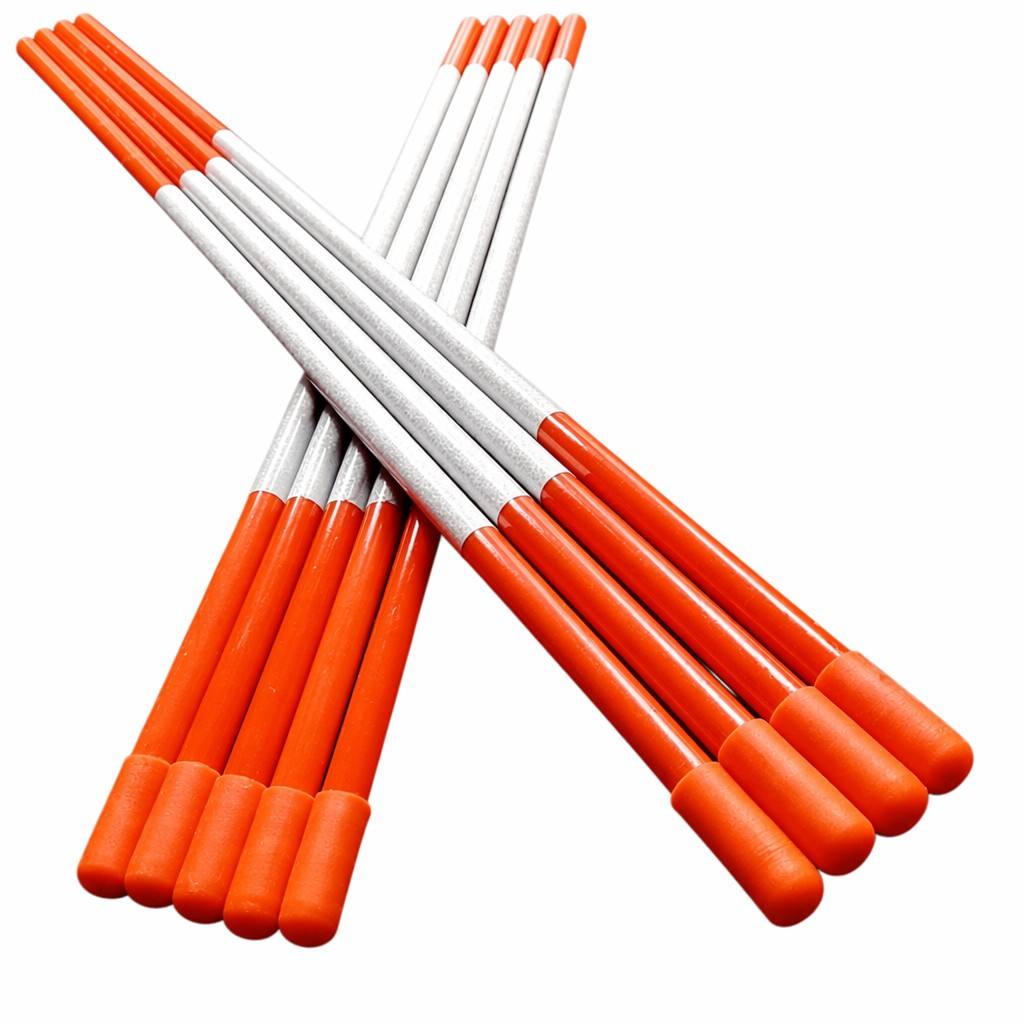
Property owners must choose between wood, metal, plastic, and fiberglass when marking boundaries. Each material behaves vastly differently under mechanical stress and severe winter weather. Understanding these differences prevents costly replacement cycles mid-season. Field experience shows that cutting corners on material selection always leads to higher labor costs when broken stakes need replacing in January.
Driveway Marker Material Comparison
Material Type | Impact Resistance | Weather Durability | Primary Weakness |
|---|---|---|---|
Wood | Low (Snaps easily) | Poor (Rots in moisture) | Leaves dangerous splinters and debris |
Metal | Low (Bends permanently) | Moderate (Prone to rust) | Causes severe damage to vehicles and plows |
Plastic | Moderate (Cracks in cold) | Moderate (Fades quickly) | Becomes highly brittle in sub-zero temps |
Fiberglass | High (Elastic flex) | Excellent (UV and freeze resistant) | Requires proper tools for frozen ground installation |
Manufacturers produce these resilient markers using a highly specialized pultrusion process. This method aligns continuous glass fibers and binds them tightly with durable polymer resins. The resulting composite rod absorbs kinetic energy exceptionally well. When struck by vehicle bumpers or heavy snow pushed by plows, the rod bends deeply. It then immediately returns to a perfect vertical position without any permanent deformation. Ground freezing after installation creates a powerful anchor effect in the soil. The frozen earth tightly secures the buried base of the marker. This secure anchor allows the fiberglass rod to achieve maximum elastic flex when struck. Instead of uprooting completely, the anchored rod simply bends under pressure and snaps back. We see this constantly on job sites. A skid steer pushes a massive pile of wet snow over the curb. The snow flattens the marker to the ground. Once the snow melts or gets moved, the rod pops right back up, completely undamaged.
Wood and metal consistently fail under rigorous winter maintenance conditions. Wooden stakes rot rapidly when exposed to continuous ground moisture and melting snow. They snap easily under the lateral pressure of heavy, wet snowbanks. Furthermore, broken wood leaves dangerous, tire-puncturing splinters behind in the grass. Metal stakes present entirely different but equally severe hazards. They rust quickly in wet, salt-heavy winter environments. Upon impact, metal bends permanently and requires manual, labor-intensive straightening. More importantly, rigid metal stakes can cause severe damage to vehicle bodies or expensive plow blades. If a plow catches a steel T-post hidden in a snowbank, it can shear the cutting edge or damage the truck's suspension system. The liability associated with metal stakes makes them an unacceptable choice for commercial snow removal contractors.
Markers must perform reliably under the most severe winter conditions imaginable. Commercial plowing operations put immense mechanical stress on all edge marking systems. Evaluating specific performance dimensions ensures you select equipment that survives the season. You must account for frost heave, ice storms, and the sheer weight of plowed snow.
Sub-zero temperatures rapidly destroy inferior plastics and untreated wooden stakes. High-density fiberglass naturally resists becoming brittle in extreme cold environments. Modern resin formulations protect both operational safety and product longevity. These advanced, splinter-free resins protect the bare hands of crews handling the poles in freezing weather. A premium Fiberglass Snow Pole maintains its structural integrity through endless freeze-thaw cycles. It will not crack when ground moisture expands and contracts around its base. The pultrusion process ensures the glass fibers remain fully encapsulated. This prevents water from seeping into the core, freezing, and splitting the rod from the inside out. When the spring thaw arrives, the markers remain intact and ready for extraction and storage.
Selecting the correct marker height depends entirely on your regional average snowfall. You must anticipate the maximum height of plowed snowbanks, not just natural accumulation. A V-plow casts snow much higher than a straight blade, requiring taller markers to remain visible.
Use 48-inch markers for geographical areas experiencing only light to moderate snow.
Choose 60-inch markers for regions facing heavy, consistent winter accumulation.
Deploy 72-inch markers where commercial plows regularly create massive, towering snow drifts.
Spacing requirements also vary significantly based on the specific application. Commercial lots require tight spacing intervals to guide heavy equipment safely around complex curbs. Residential driveways can often utilize wider spacing intervals along straight property lines. For tight radius corners, place markers every three to five feet to clearly define the curve for the plow operator.
Buyers must evaluate specific technical specifications to ensure long-term field performance. Matching physical features to your desired operational outcomes prevents premature product failure. Careful procurement saves significant replacement labor later in the winter. You need to look beyond the basic color and examine the engineering details of the rod.
Reflective Tape Grade Comparison
Tape Grade | Reflective Technology | Visibility Range | Best Application |
|---|---|---|---|
Engineer Grade (EG) | Enclosed Glass Beads | Short (up to 500 ft) | Residential driveways, low-speed areas |
High-Intensity Prismatic (HIP) | Micro-prismatic | Medium (up to 1,000 ft) | Commercial lots, rural roads |
Diamond Grade (DG) | Full-cube Prismatic | Long (up to 1,500 ft) | High-speed highways, industrial sites |
Not all reflective tapes perform equally in harsh winter conditions. Standard commercial tape often peels off after just a few weeks of moisture exposure. Engineering-grade reflective material provides superior luminosity and exceptional longevity. Manufacturers typically place this tape near the very top of the rod. The chemical adhesive used must resist both heavy moisture penetration and deep freezing temperatures. If the tape fails, the marker loses its entire nighttime visibility function. Look for tapes that use micro-prismatic technology rather than older glass bead designs. Prismatic tape reflects a much higher percentage of light back to the source, making the marker appear significantly brighter in low-light conditions.
Rod diameter directly dictates both the flexibility and the overall strength of the marker. You must balance the need for flexibility against the need for rigidity. Soil type also plays a role; driving a thick rod into dense clay requires more effort than a thin rod.
1/4-inch rods offer extreme flexibility but may whip aggressively in high winds.
5/16-inch rods provide a highly balanced standard for most typical residential applications.
3/8-inch rods deliver maximum wind and snow-load resistance for demanding commercial sites.
Thinner rods bend easily under light pressure but may sag under heavy snow. Thicker rods stand rigid against heavy, wet snowbanks but offer slightly less impact flex. If you operate in an area with heavy, wet coastal snow, lean toward the 3/8-inch diameter to prevent the rods from bowing under the weight of the snowpack.
Installation requires physically driving the markers deep into the ground. Protective top caps prevent top-down splintering when struck repeatedly with a heavy mallet. Polymer surface coatings add an extra layer of vital protection against UV rays and rough handling damage. Finally, chamfered or pointed bottom ends are absolutely necessary for deployment. They allow for efficient, straight ground penetration without crushing or damaging the internal rod structure. A blunt end will mushroom upon impact with a rock, ruining the rod before it even gets into the soil. Always ensure the markers you purchase feature a factory-ground point.
Deploying markers at scale presents several practical logistical challenges. Proper planning prevents damaged inventory and wasted labor hours during installation. Understanding these realities ensures a smooth transition into winter readiness. You must coordinate your installation schedule with the local frost line predictions.
Attempting to force markers into already-frozen ground is a major operational risk. This action almost always leads to splintering, bending, or completely breaking the rod. Early-season deployment schedules serve as the best possible mitigation strategy. Install all markers firmly before the first hard freeze hits your region. Drive them at least six to eight inches into the subgrade to prevent frost heave from pushing them out. If you must install in frozen ground, you must use pre-drilling tools. Specialized steel installation spikes create a perfect, damage-free pilot hole for the fiberglass rod. Alternatively, a rotary hammer drill with a long masonry bit makes quick work of frozen topsoil.
Commercial snow removal contractors face unique logistical challenges regarding scale. Bulk purchasing requires careful consideration of both volume needs and physical storage space. Sourcing 50-packs or full pallet quantities significantly reduces per-unit procurement friction. Off-season storage protocols are equally important for protecting your investment. Store all markers flat in a dry, dark place during the summer months. Do not lean them against a wall, as the summer heat will cause them to permanently bow. This simple flat-stacking practice maximizes the lifespan of both the fiberglass resin and the reflective tape adhesive.
Fiberglass remains the undisputed industry-standard material for professional edge marking. It achieves highly reliable nighttime visibility while offering unmatched seasonal durability. Its unique elastic flex prevents permanent damage from accidental vehicle strikes and heavy snow loads. Buyers should base their final decision primarily on regional snowfall, which dictates necessary height. Traffic volume and local plow types dictate the necessary rod diameter and flex profile. The installation tools you have available will also heavily influence your deployment timeline.
Take these actionable steps to secure your property boundaries:
Calculate the total required linear footage of the pavement edges you need to mark.
Determine the necessary marker spacing based on your specific curves and straightaways.
Select the appropriate rod diameter and height for your unique property layout and weather.
Procure specialized steel pilot hole tools if installing after the ground has already frozen.
A: Standard spacing is typically 10 to 15 feet for straightaways. You should place them closer together on curves or sharp corners to clearly define the turning radius. Integrating them with ground-level pavement markers provides the best overall visibility for drivers.
A: Yes, they can splinter due to severe UV degradation or improper installation techniques. Forcing them into hard ground without a pilot hole damages the glass fibers. You can mitigate this by choosing polymer-coated options and using proper steel installation tools.
A: We strongly recommend 60-inch to 72-inch poles for regions with high snow accumulation. These taller heights ensure the reflective bands remain clearly visible above deep snowbanks and massive commercial plow drifts throughout the entire winter season.
A: They feature elastic flex and can survive accidental run-overs, especially when anchored securely by frozen ground. The rod will bend and snap back. However, repeated direct tire strikes will eventually cause structural failure and ruin the reflective tape.
A: Never strike the fiberglass directly to force it into frozen soil. You must use a specialized steel pilot hole tool or a long masonry drill bit. Create the hole first, then slide the marker securely into place to prevent splintering.
A: While orange and green offer excellent daytime contrast against snow, nighttime visibility depends almost entirely on the reflective tape. The quality, placement, and 360-degree integration of the engineering-grade reflective band determine how well drivers see the marker at night.
