
close
Choose Your Site
Global
Social Media


Views: 0 Author: Site Editor Publish Time: 2026-10-19 Origin: Site


Navigating a pitch-black driveway or garden path presents significant challenges for homeowners and commercial property managers alike. Without proper visual guidance, nighttime navigation often leads to costly accidents and safety hazards. Poor nighttime visibility frequently results in heavy snowplow damage, vehicle encroachment onto lawns, and trampled landscaping elements.
Property owners often confuse photoluminescent and retroreflective technologies when trying to solve these issues. Selecting the wrong marking technology leaves your boundaries invisible exactly when you need them most. This comprehensive guide breaks down the core differences between various marker types to help you make an informed choice.
You will discover how to evaluate visibility distance, material durability, and maintenance requirements for your specific property layout. Ultimately, you will learn exactly which marking solution guarantees safety and protects your valuable landscape against harsh environmental conditions.
Light Dependency: Glow-in-the-dark marker sticks require daytime UV exposure to charge and emit a passive glow, while reflective stakes require an active light source (like headlights) to function.
Primary Applications: Reflective markers are essential for motorized traffic and driveways; glow-in-the-dark options are better suited for pedestrian pathways and off-grid landscaping.
Material Durability: Most heavy-duty reflective stakes utilize flexible fiberglass cores and protective hammer caps, outperforming standard plastic glow sticks in high-impact zones.
Alternative Solutions: Active LED markers bridge the gap for high-visibility needs without relying on headlights or UV charging, though they introduce battery/solar maintenance.
Choosing the right boundary marker begins with understanding how different materials interact with light. We frequently see property owners install passive glow stakes along a fast-moving driveway, only to realize drivers cannot see them. To prevent these costly mistakes, you must understand the underlying science of photoluminescence and retroreflection.
Photoluminescent materials operate through a fascinating chemical mechanism. They absorb ambient ultraviolet (UV) light during the day and store this energy. As darkness falls, the material slowly releases stored photons. This creates a visible, passive glow.
However, you must consider the implementation reality. Glow intensity peaks heavily in the first one to two hours after sunset. Following this initial burst, the brightness degrades to a low-level hum. By early morning, the glow becomes barely perceptible. Furthermore, heavy overcast skies during winter months drastically reduce the daytime charge. If they do not receive enough direct sunlight, they will underperform when you need them most.
Retroreflection utilizes an entirely different approach. Instead of storing light, it bounces an active light source directly back toward the point of origin. Micro-prisms embedded in the marker surface catch incoming light from headlights or flashlights and return it in a tight, concentrated beam.
The implementation reality here is strictly binary. When hit by a directed light source, these markers are highly visible from hundreds of feet away. They cut through fog, heavy rain, and blowing snow. Yet, they remain functionally invisible in absolute darkness. If a pedestrian walks near them without a flashlight, they will not see the marker.
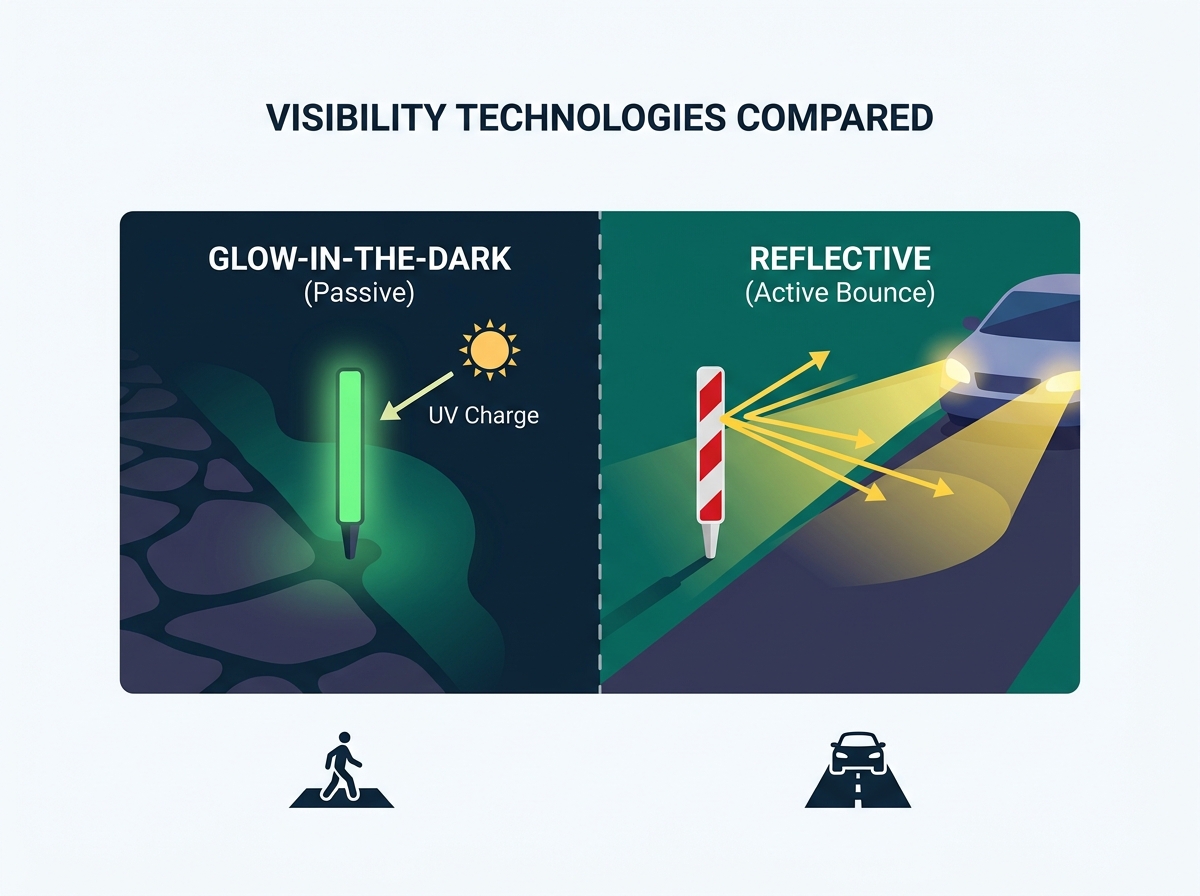
When you want subtle, off-grid visibility, glow-in-the-dark marker sticks provide an excellent solution. They operate silently and passively, requiring zero electricity or vehicle headlights.
Their best use cases revolve around pedestrian traffic. Walkways, garden beds, camping perimeters, and pedestrian-only zones benefit greatly from these stakes. When vehicular headlights are absent, a soft glowing guide path keeps guests on the pavement and out of your flowerbeds.
The pros are straightforward. They require no active light source to be seen by pedestrians. They also offer a subtle aesthetic. Unlike harsh electric lights, they do not cause light pollution or disturb nocturnal wildlife in your garden.
However, you must acknowledge their risks and limitations. They remain highly dependent on seasonal sunlight. If you live in a region suffering from prolonged winter overcast, they perform poorly. Additionally, they have a limited visibility range. Even fully charged, they typically remain visible only under 30 feet away.
Purchasing considerations require careful attention to material chemistry. To maximize performance, follow these key steps:
Check the pigment type: Always look for high-grade strontium aluminate pigments. They glow ten times brighter and last much longer than traditional zinc sulfide.
Evaluate the core material: Ensure the stick uses a durable resin or thick acrylic to protect the glowing pigment from UV degradation over time.
Assess the height: Choose a height clearing your average expected snowfall or plant growth to maintain visibility.
For heavy-duty applications involving vehicles, reflective garden markers serve as the industry standard. These stakes form a brilliant perimeter when struck by approaching headlights.
Their best use cases target high-risk zones. They excel in driveway perimeters, snowplow routing maps, and commercial property lines. When you need to keep a two-ton plow truck off your expensive turf, reflection provides the strongest defense.
Consider these primary pros and cons when evaluating them:
Pro - Extreme Visibility Range: High-quality micro-prismatic tape flashes brilliantly from hundreds of feet away, giving drivers ample reaction time.
Pro - Weather Penetration: The concentrated bounce of light easily cuts through heavy precipitation, sleet, and dense fog.
Con - Darkness Blindness: They prove unhelpful for off-grid foot traffic. A person walking the dog at night without a flashlight will easily trip over them.
Con - Material Delamination: Reflective tape can peel over time if constantly exposed to heavy road salt or physical scraping from snowplow blades.
When purchasing landscape boundary markers, you must demand standard industry specifications. Look for 1/4-inch to 5/16-inch fiberglass poles. This thickness ensures flexibility under high winds without snapping. They must feature omnidirectional reflective banding so drivers see them from any approach angle. Finally, insist on integrated impact caps to protect the fiberglass during installation.
Selecting the ideal boundary system requires evaluating your specific environment, soil, and scale. We utilize a structured decision framework to match the technology to the terrain.
Table: Marker Technology Comparison Matrix
Feature | Photoluminescent (Glow) | Retroreflective |
|---|---|---|
Light Requirement | Daytime UV Exposure | Direct Headlight / Flashlight |
Visibility Range | Low (Up to 30 feet) | High (Up to 300+ feet) |
Best Application | Pedestrian walkways, gardens | Driveways, snowplow routes |
Weather Vulnerability | Overcast skies reduce charge | Tape peeling from road salt |
You must assess wind shear and snow-load resistance. Fiberglass cores offer distinct advantages over rigid plastics. When heavy wet snow pushes against a fiberglass pole, it bends gracefully and springs back. Rigid plastics simply snap under the same load.
Cold weather brittleness also plays a massive role. Standard PVC materials shatter easily in sub-zero temperatures. Always verify the stakes you purchase maintain their structural integrity during deep winter freezes.
Installation poses a significant risk to both the stake and your hands. Ground penetration risks run high if you hammer directly onto raw fiberglass. You will cause severe splintering, ruining the stake and risking painful fiberglass shards in your skin. The necessity of integrated hammer caps cannot be overstated. These durable plastic or metal caps absorb the kinetic energy of your mallet.
Soil conditions dictate your installation method. Driving stakes into frozen or densely compacted earth requires preparation. We strongly recommend using a steel spike or a long masonry drill bit to create pilot holes. Dropping the stake into a pre-drilled pilot hole ensures a perfectly vertical alignment and zero structural damage.
Proper planning prevents budget overruns. Calculating bulk pack requirements depends entirely on your layout. Marking a long rural driveway requires significantly more stakes than localized garden accenting.
Calculate your cost per linear foot by walking the boundary line. Divide the total footage by your chosen spacing interval. Purchasing bulk packs of 50 or 100 stakes for long driveways drastically reduces the individual unit price. Plan your entire layout before buying to maximize efficiency.
Sometimes, neither passive glow nor active reflection meets rigorous safety requirements. We call this the visibility gap. Dark, curved driveways with low-angle approaches create blind spots. If a vehicle's headlights do not hit the reflective tape directly due to a sharp curve, the driver remains blind to the boundary. In these scenarios, active LED stakes become necessary.
Active markers project their own light. You must weigh the pros and cons of battery versus solar power. Wired or battery-operated LEDs offer supreme reliability, glowing brightly regardless of the weather. However, they require frequent battery replacements or complex trenching for wires.
Solar-powered stakes provide a maintenance-free alternative. They charge during the day and illuminate automatically at dusk. Keep in mind their weather-dependent nature. Just like passive glow stakes, consecutive cloudy winter days will severely limit a solar LED's nighttime performance.
You must justify the higher initial investment and maintenance of LEDs. Weigh this upfront price against the cost of potential property damage. Replacing a ruined section of premium turf or a shattered retaining wall far exceeds the price of installing reliable LED markers at a dangerous intersection.
Securing your property lines against nighttime hazards requires matching the right technology to your specific environment. A blanket approach rarely yields the best results. Utilize a targeted strategy based on traffic type and ambient conditions.
Our final recommendation matrix simplifies the decision. Choose reflective stakes for vehicles, snowplows, and driveway boundaries where headlights are guaranteed. Choose glow-in-the-dark marker sticks for subtle pedestrian pathway guidance in off-grid garden areas. Choose active LED markers for high-risk, zero-light intersections where headlights cannot reach in time.
For your next steps, take a measuring wheel and walk your property lines. Advise on measuring linear footage to determine bulk-pack quantities accurately before purchasing. Proper measurement prevents the frustration of running out of stakes halfway down your driveway. Invest in quality fiberglass cores and install them with care, and your property will remain safe and visible year-round.
A: The illumination duration depends heavily on daytime UV exposure. You will notice a bright peak brightness for the first 1 to 2 hours after sunset. Afterward, it transitions into a visible afterglow. High-quality strontium aluminate markers typically maintain this subtle glow for 4 to 8 hours.
A: Yes. In fact, streetlights are entirely irrelevant to their function. Reflective stakes only work when struck by a direct, active light source like vehicle headlights or a flashlight. The micro-prisms bounce that specific light back to the driver's eyes, making them highly effective on pitch-black rural roads.
A: Never strike fiberglass directly into frozen earth, as the core will shatter. Use a long masonry drill bit or a heavy steel spike to create pilot holes first. Once you create the hole, drop the stake inside and tap it gently into place using a stake with an integrated hammer cap.
A: Proper spacing ensures drivers can map the boundary visually without missing gaps. The standard recommendation is 10 to 15 feet apart for long straightaways. For sharp curves, intersections, and cul-de-sacs, tighten the spacing to 5 to 8 feet to provide a clear, continuous visual line.
