
close
Choose Your Site
Global
Social Media


Views: 0 Author: Site Editor Publish Time: 2025-11-06 Origin: Site


For decades, rods made of metal were the default choice in industries ranging from construction to fishing and sports equipment. Metals like steel and aluminum have long been trusted for their strength and availability. However, in the past few decades, fiberglass rods have emerged as a strong competitor, offering a unique set of benefits that make them attractive for many modern applications. The debate between fiberglass rods and metal rods now goes beyond tradition versus innovation—it is about performance, cost, and long-term value.
This article provides a detailed comparison of fiberglass rods and metal rods, focusing on their strength, durability, and cost. By examining these factors closely, we can better understand why fiberglass rods are increasingly replacing metals in certain industries while metals still remain dominant in others.
Fiberglass rods are made from extremely fine glass fibers woven together and reinforced with resin to create a strong yet lightweight composite. This combination of materials results in rods that are flexible, resistant to corrosion, and capable of withstanding significant stress without permanent deformation. Unlike natural materials like wood or heavy metals, fiberglass offers consistency and adaptability, making it suitable for a wide range of uses.
Metal rods, on the other hand, include materials like steel, aluminum, and sometimes alloys designed for specific applications. Metals have historically been the go-to choice due to their high tensile strength, load-bearing capabilities, and well-understood performance characteristics. They are still widely used in construction, heavy machinery, and applications where maximum rigidity is required.
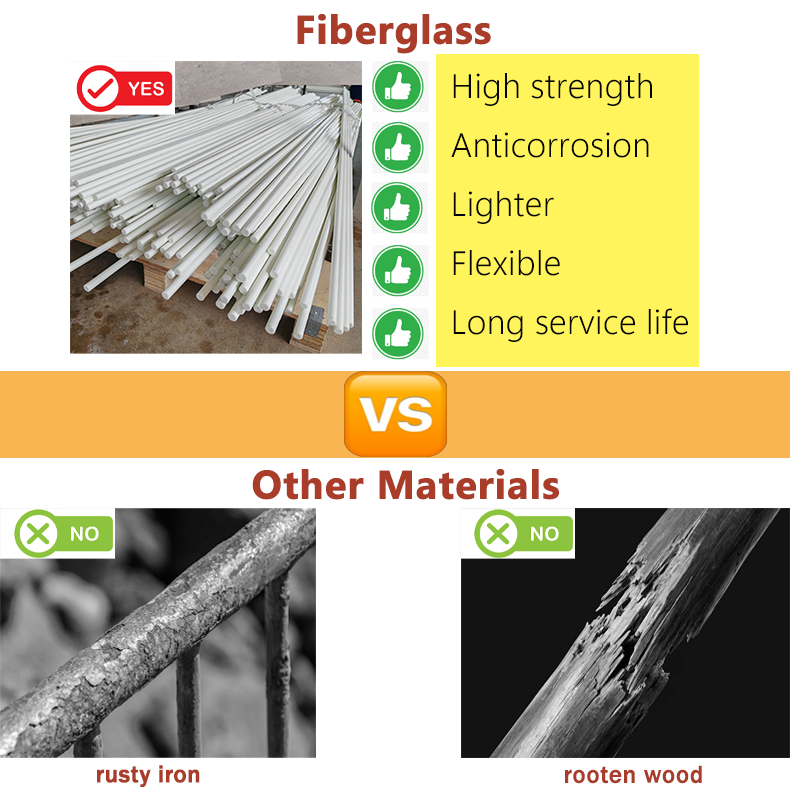
Strength is often the first quality people consider when choosing a material.
Fiberglass rods provide excellent tensile strength, meaning they can withstand pulling forces without breaking. They are also flexible, which allows them to absorb shocks and impacts without snapping. For example, in fishing rods or pole vaulting poles, fiberglass offers the ideal balance between strength and flexibility.
Metal rods, particularly steel, are unmatched in pure tensile and compressive strength. They can support massive loads in construction projects, bridges, and industrial machinery. However, their rigidity can be a disadvantage in applications requiring flexibility. Unlike fiberglass, metals do not bend easily without retaining permanent deformation or breaking under excessive stress.
In short, fiberglass excels where flexibility and shock absorption are critical, while metals dominate in applications requiring maximum rigidity and high load-bearing capacity.
Durability is another area where fiberglass rods often outperform metals, depending on the environment.
Metals such as steel are extremely durable under controlled conditions but can corrode when exposed to moisture, salt, or chemicals. Even aluminum, which is more resistant to rust, can weaken when exposed to certain environmental conditions. This means metal rods often require coatings, treatments, or regular maintenance to preserve their longevity.
Fiberglass rods, by contrast, are naturally resistant to moisture, corrosion, and chemical exposure. They do not rust or rot, even in coastal environments where salt is abundant. Their resistance to weathering makes them especially valuable for outdoor and marine applications. However, fiberglass is not indestructible—it can weaken under extreme UV exposure or if subjected to continuous high-impact stresses. Still, with proper design and occasional maintenance, fiberglass rods tend to outlast metals in environments that are harsh or corrosive.
Another important factor in durability is how a material behaves under heat and electricity. Metals are excellent conductors of both, which makes them unsuitable for insulation or applications where electrical safety is paramount. Fiberglass rods, being non-conductive, are often chosen for electrical insulation, safety equipment, and environments where electricity poses a hazard.
In terms of heat, fiberglass can resist higher temperatures than many plastics, maintaining strength and integrity in demanding environments. Metals can also withstand high heat, but their conductivity means they may not be safe for direct use in electrical or thermal insulation applications.
Cost often determines which material is chosen, especially for large-scale projects.
Fiberglass rods typically cost more upfront than some metals like untreated steel. However, when long-term maintenance and replacement costs are considered, fiberglass can prove more economical. Since fiberglass resists corrosion and does not require protective coatings or frequent replacements, it saves money over time.
Metal rods, while cheaper in some cases, often come with hidden costs. Regular maintenance, anti-rust treatments, and eventual replacement due to corrosion or fatigue add to the total expense. In addition, metals are heavy, which can increase transportation and installation costs. Fiberglass rods, being lightweight, reduce both labor and logistics expenses.
Therefore, while metal rods might win in initial affordability, fiberglass rods frequently provide better long-term value, especially in environments prone to corrosion or requiring frequent handling.

Fiberglass rods are widely used in industries where flexibility, light weight, and corrosion resistance are valuable. Examples include:
Fishing gear and sports equipment, where shock absorption and flexibility enhance performance.
Electrical insulation and safety tools, such as hot sticks, ladders, and non-conductive supports.
Construction projects exposed to corrosive environments, like seawalls, bridges, and wastewater treatment facilities.
Automotive applications, such as engine compartment insulation films where heat and non-conductivity are important.
Metal rods remain dominant in heavy-duty applications requiring maximum rigidity and load-bearing strength. Examples include:
Structural construction, such as skyscrapers, bridges, and industrial machinery.
Transport infrastructure, including railways, shipbuilding, and aerospace, where strength is prioritized.
Machinery parts, where precise, rigid components are required for smooth operation.
It is not always a case of one material replacing the other. In many industries, fiberglass rods and metal rods complement one another. For instance, a construction project might use steel for its main structural framework but rely on fiberglass components for insulation or environmental protection. Similarly, sports equipment manufacturers often blend fiberglass with carbon fiber or metals to achieve specific performance characteristics.
The choice ultimately depends on the application: when flexibility, resistance to environmental stress, and long-term value are required, fiberglass rods shine. When raw strength and rigidity are non-negotiable, metal rods remain the leader.
As industries increasingly focus on sustainability and efficiency, fiberglass rods are expected to grow in popularity. Advances in composite technologies are making them stronger, more affordable, and more versatile. At the same time, the demand for lightweight materials that reduce transportation emissions and extend product lifespans aligns well with the advantages of fiberglass.
Metals, however, will not disappear. Innovations in alloy design and corrosion-resistant treatments continue to make metals relevant for construction and heavy industries. What is more likely is a future where fiberglass rods and metal rods coexist, each fulfilling roles best suited to their unique properties.

The comparison between fiberglass rods and metal rods highlights how material science shapes modern industry. Fiberglass rods bring flexibility, corrosion resistance, non-conductivity, and long-term cost efficiency, making them ideal for fishing gear, electrical insulation, and construction in harsh environments. Metal rods, with their unmatched rigidity and strength, remain essential in load-bearing and structural applications.
While metals dominate where brute force is needed, fiberglass rods excel in environments that demand resilience and low maintenance. The growing trend toward sustainable, lightweight, and adaptable materials ensures that fiberglass rods will continue to gain ground in industries that were once the sole domain of metals.
Companies like Jiangxikai New Materials Co., Ltd. are contributing to this progress by developing high-quality fiberglass solutions that meet the evolving needs of modern industries, helping create safer, stronger, and more sustainable applications worldwide.
