
close
Choose Your Site
Global
Social Media


Views: 0 Author: Site Editor Publish Time: 2026-10-08 Origin: Site


The increasing demand for high-durability, cost-effective composite sports equipment is forcing manufacturers to re-evaluate base materials. While carbon fiber dominates lightweight premium markets, product teams must carefully balance peak performance against escalating manufacturing costs. You must also consider user error tolerance and long-term material longevity in unpredictable outdoor environments. Rigid premium materials often fail catastrophically under unexpected sheer stress. Everyday consumers demand gear capable of surviving heavy abuse without requiring constant replacements. For applications requiring extreme flex, sudden impact resistance, and long-term cost scalability, glass fiber reinforced plastic rods present a highly compelling alternative to carbon, steel, or traditional wood. Provided your engineering teams fully understand their specific mechanical limitations, these materials unlock massive design potential. We will explore exact yield thresholds and optimal manufacturing use cases. You will discover practical sourcing strategies to elevate your next product line reliably.
Cost-to-Toughness Ratio: Offers superior impact resistance and flexibility compared to stiffer, more brittle alternatives like carbon fiber.
Application Specificity: Ideal for sporting goods where parabolic bending and impact survival are prioritized over absolute weight reduction (e.g., heavy-duty fishing gear, archery bows, structural frames).
Manufacturing Realities: Requires strict QA regarding resin selection (epoxy vs. polyester) and machining processes to prevent delamination and ensure scalability.
Procurement Shift: Sourcing success depends on clearly defined flex tolerances and understanding the pultrusion process.
Modern consumers expect sports gear to withstand immense physical punishment. High-durability segments demand smart, resilient material choices. Brands face intense margin pressures when sourcing components for mid-tier markets. Fiberglass components fit perfectly into this specific market positioning. They balance affordability and resilience better than competing metals or exotic composites. When developing new product lines, we must frame material decisions around practical realities.
How do we evaluate success? We look directly at cost-per-unit metrics, stress defect rates, and long-term warranty claims. You want fewer broken products returned by frustrated customers. A snapped pole or shattered frame damages brand reputation instantly. By prioritizing impact survival, you reduce negative reviews and costly replacement shipments. Products using glass composites routinely show lower failure rates during aggressive stress testing.
Cost scalability remains a massive advantage. Raw fiberglass materials cost significantly less than advanced aerospace-grade carbon composites. Pultrusion manufacturing processes also drive component prices down efficiently. Pultrusion creates continuous profiles rapidly, dropping labor costs. You can scale production volumes without facing severe supply chain bottlenecks. This cost advantage allows brands to reallocate budgets toward better grips, enhanced marketing, or superior packaging.
Engineers often analyze the parabolic bending curve to understand material limits. Glass fiber excels in continuous stress applications without snapping. It distributes mechanical loads evenly across the entire shaft. Wood snaps when pushed past modest limits. Steel bends permanently, suffering from plastic deformation. Glass composites return to their original straight form reliably. They endure thousands of bending cycles without losing structural integrity.
Yield thresholds matter immensely in sporting goods design. We measure how far a material bends before structural failure occurs. Industry standard ASTM D790 flexural tests prove glass fiber possesses an incredibly wide elastic region. You can bend these shafts into extreme U-shapes. Traditional materials fail long before reaching such extreme angles. This flexibility keeps gear functioning under erratic user loads.
Evidence-based durability drives consumer trust. Fiberglass handles blunt force trauma and micro-impacts exceptionally well. If you drop a highly rigid carbon shaft on a sharp rock, it often cracks. Micro-fractures grow quickly under tension. Glass fiber absorbs this blunt force safely. It handles cyclic fatigue better during repetitive impacts.
Environmental degradation ruins many sports products prematurely. Outdoor gear faces brutal weather conditions daily. Glass composites offer immense resistance to saltwater corrosion and extreme temperature fluctuations. They do not rust like steel tubing. They resist becoming dangerously brittle in sub-zero winter temperatures. This elemental resistance ensures long-lasting performance across diverse climates.
We must acknowledge a transparent, skeptical view regarding these materials. Glass composites possess a lower stiffness-to-weight ratio than carbon composites. They are undeniably heavier and denser. If you design ultra-lightweight racing bicycles, you will likely avoid them. The weight penalty is real.
However, this weight penalty is frequently acceptable—or even preferred—in specific scenarios. In momentum-driven or stationary gear, added mass provides distinct advantages. It stabilizes archery equipment during release. It adds necessary kinetic energy to heavy-duty strike tools. We trade absolute lightness for absolute toughness. You make a deliberate compromise to guarantee product survival.
Anglers face unique mechanical challenges when fighting large fish. Crankbait and heavy-cover fishing require specific tackle dynamics. Many professional anglers prefer fiberglass rods for sporting goods in these scenarios. They offer a highly forgiving, slower action. When a fish strikes a moving lure, a stiff shaft often rips the hook free. Glass materials delay the hookset naturally. This slower lure-retrieval mechanic keeps fish securely pinned during chaotic fights. The deeper flex profile absorbs violent headshakes effortlessly.
Target sports rely on repetitive dynamic stress. Archery bow limbs store and release massive amounts of kinetic energy repeatedly. Glass composites serve as the foundational backbone for recurve limbs and youth bows. They deliver consistent energy transfer shot after shot. Training arrows also utilize these materials heavily. Beginners miss targets often, hitting wooden frames or rocks. Glass arrows survive these harsh impacts, providing incredible cost-efficiency for ranges and schools.
Many sporting applications require hidden structural support. We integrate these flexible components into various safety and training systems daily. They provide necessary shatter resistance and structural memory.
Golf Alignment Sticks: Players drop them, step on them, and toss them into bags. They require total shatter resistance.
Tent Poles: Outdoor shelters demand extreme flexibility to withstand high winds without snapping.
Kite Frames: Power kites endure aggressive aerodynamic loads and frequent crash landings.
Batting Cage Nets: High-velocity baseball impacts require flexible support frames to absorb kinetic energy safely.
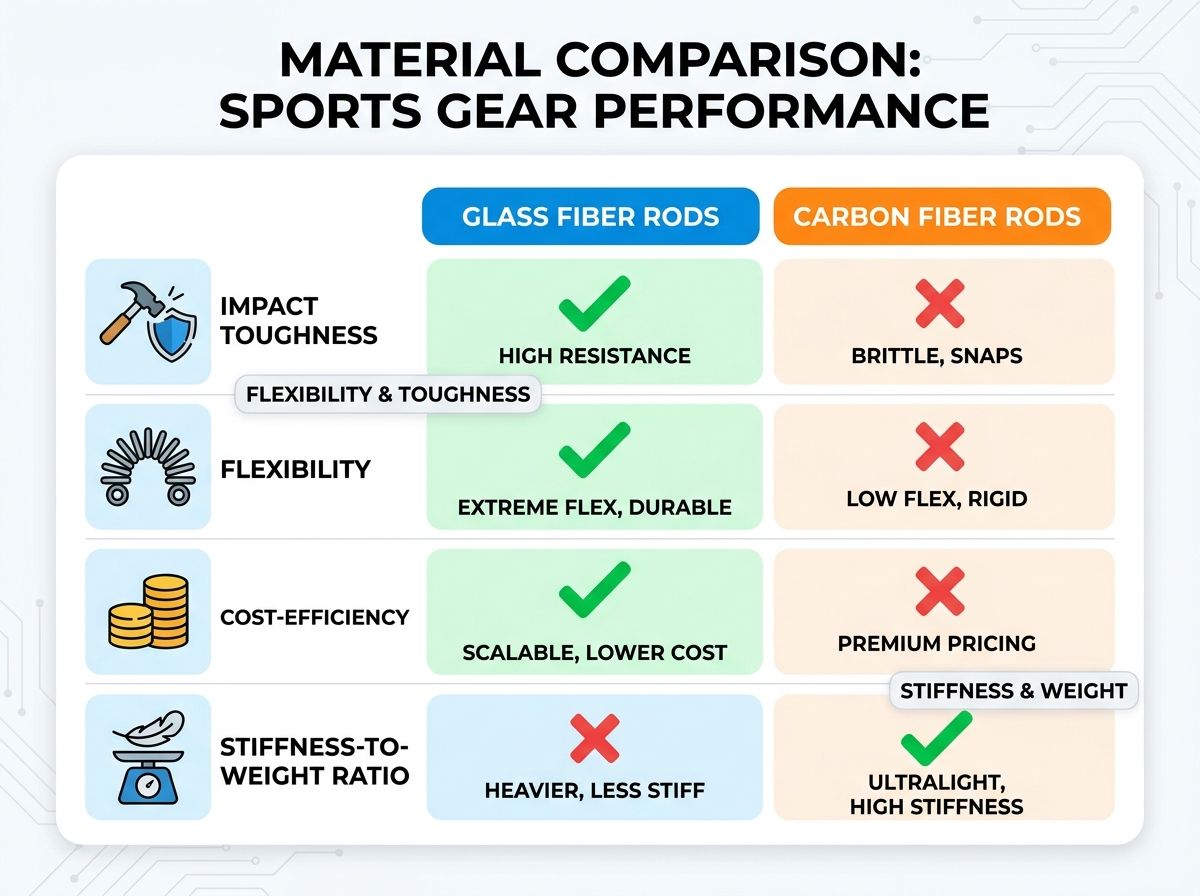
Product teams constantly debate between these two dominant composites. We must contrast their primary characteristics to make informed manufacturing decisions. Carbon delivers immense stiffness and high sensitivity. It transfers tactile feedback brilliantly, which matters in precision gear. Glass composites provide superior load-bearing flex. They stretch further before reaching critical breaking points.
Brittleness dictates failure modes. Carbon typically snaps catastrophically under excess load. It breaks suddenly, creating dangerous, sharp edges. Glass composites fail progressively. They splinter or delaminate slowly. You can often hear or see the material failing before it separates completely. This progressive failure provides a crucial safety warning for athletes.
Feature Category | Carbon Fiber | Glass Fiber | Ideal Application |
|---|---|---|---|
Stiffness-to-Weight | Exceptionally High | Moderate to Low | Racing gear vs. Impact gear |
Failure Mode | Catastrophic Snapping | Progressive Splintering | Predictable safety warnings |
Flexural Yield | Low (Stiff) | Extremely High (Bendy) | Tactile feedback vs. Deep flex |
Cost Scalability | Expensive | Highly Economical | Premium vs. Mass market |
Hybrid solutions offer exciting engineering pathways. We explore composite blending to achieve optimal price-to-performance ratios. You can design a carbon-core shaft and wrap it in a tough fiberglass outer layer. The inner core provides necessary stiffness. The outer wrap protects against blunt force impacts. This hybrid approach delivers the best traits of both materials.
Engineers must respect factory-floor realities when introducing new materials. Machining these composites presents distinct challenges. Standard cutting blades dull rapidly. Tool wear increases production costs if you ignore proper equipment upgrades. We recommend diamond-coated cutting wheels. Furthermore, cutting creates hazardous airborne dust. Factories require robust ventilation and strict dust management systems to protect worker respiratory health.
Delamination and splintering risks haunt poor-quality manufacturing runs. How do structural failures happen? Poor-quality pultrusion speeds leave dry spots in the material matrix. Improper end-capping leaves raw fibers exposed to moisture and fraying. You must seal the cut ends properly.
Resin matrix selection dictates overall lifespan. The fibers provide strength, but the resin holds everything together. There is a critical difference in performance when specifying standard polyester resins versus high-grade epoxy resins.
Best Practices: Specify epoxy resins for high-end gear requiring maximum fatigue life. Ensure all cut ends receive proper sanding and chemical sealing. Request rigorous UV-resistant coatings for outdoor applications.
Common Mistakes: Choosing cheap polyester resin for heavy-load equipment. Skipping final polish steps, leaving micro-splinters on user-facing surfaces. Ignoring dimensional tolerance checks during bulk receiving.
Defining exact specifications prevents massive supply chain headaches. When writing RFQs (Requests for Quotes), avoid vague language. Document precise outer diameters and acceptable dimensional tolerances. Clearly state the required flexural modulus. Specify UV-coating requirements if the gear lives outdoors. The more details you provide, the more accurate your manufacturing quotes become.
You must choose between pultrusion and roll-wrapped methods. Selecting the right manufacturing method depends entirely on your geometry. Pultrusion produces solid, continuous profiles rapidly at a lower cost. Roll-wrapping involves wrapping pre-impregnated fabric around a mandrel. It costs more but creates highly precise hollow tubes. Evaluate whether your application requires solid mass or hollow lightness.
Implementing a strict sampling protocol saves money. Never order bulk quantities blindly. Evaluate supplier test batches carefully. Measure dimensional consistency using digital calipers. Check the resin-to-fiber ratios. Perform aggressive in-house bend tests before signing volume contracts. Verify they meet your specific engineering demands.
Glass fiber reinforced plastic rods are an optimal, reliable choice for sporting goods demanding rugged durability. They handle extreme flexion and sudden impacts far better than rigid alternatives. They offer scalable production costs, making them perfect for mass-market product lines. While heavier than exotic composites, their progressive failure modes enhance user safety significantly.
Your actionable next step is simple. Contact certified B2B composite manufacturers and request exact Material Data Sheets (MDS). Ask for physical samples featuring different resin matrixes. Bring these samples into your testing facility. Conduct rigorous, in-house stress testing to find the perfect flex profile for your next sports equipment project.
A: Yes. Fiberglass is denser and heavier, making it less suitable for ultra-lightweight applications but superior for impact absorption and deep flex.
A: Base fiberglass is susceptible to UV degradation, but quality manufacturers apply UV-resistant resins or synthetic coatings to ensure outdoor longevity for sports gear.
A: Standard sizes are often available off-the-shelf, but custom diameters, flex profiles, or specific color pigments usually require MOQs determined by the manufacturer's pultrusion run lengths (often ranging from 500 to 2,000 meters).
